


A well-designed Australian native garden is genuinely low maintenance, but only when the underlying design decisions are correct from the start. Whether you are working with a small courtyard in Sydney, a property on the Northern Beaches, a rural site in NSW, a home in the Southern Highlands, or a garden in South East Queensland, the principles are the same: match your plants to the site, resolve drainage before planting, and work with the local climate rather than against it. This guide covers how to approach each of those decisions.
Why Australian Native Gardens Work So Well for Low Maintenance
The reason native gardens are inherently lower maintenance is that the plants have evolved over thousands of years to suit Australian soils, rainfall cycles, and seasonal extremes. They are ecologically matched to the conditions they grow in.
Once established, Australian native plants require less water, less fertiliser, and less active pest management than exotic species. The site works for them, rather than against them.
That said, low maintenance is a design outcome, not a plant category. A poorly sited, inadequately drained, or overcrowded planting will generate ongoing intervention regardless of species. The discipline is in the design decisions made before a single plant goes in the ground.
Start with a Site Analysis: The Step Most Homeowners Skip
Before any plant selection, the site itself needs to be understood. A thorough site analysis is the foundation of every successful low-maintenance landscape design. It is also the step most commonly skipped by homeowners working without professional advice, and the most common reason gardens underperform.
What a site analysis covers
- Soil type: Clay, sandy, and loam soils behave differently and suit different species. Heavy clay holds moisture and drains slowly; sandy soils dry out quickly. Plant selection needs to match your soil profile, not the other way around.
- Drainage patterns: Where water pools after rain, where it runs, and where it sits are all critical to know before planting. Poor drainage causes more plant loss than almost any other factor.
- Sun and shade: Sunlight patterns shift across the day and across seasons. A north-facing position sunny in summer may be shaded for extended periods in winter.
- Aspect and wind exposure: North-facing aspects receive more solar radiation. Coastal sites face salt-laden winds. The Southern Highlands and Southern Tablelands experience frost. Each of these variables shapes the planting palette significantly.
- Existing vegetation and subsoil: Established trees, root systems, and compacted subsoil all affect what can be planted and where. These conditions are best identified before design, not after.
Choosing the Right Australian Native Plants for Your Climate and Soil
Plant selection is where most native gardens succeed or fail. Choosing species poorly suited to the local conditions creates a garden that requires constant intervention. Selecting to site creates one that progressively needs less.
| Plant | Best Climate | Key Feature | Maintenance Level |
|---|---|---|---|
| Grevillea (prostrate varieties) | Wide range across Australia | Year-round flowering, attracts native birds | Very low |
| Lomandra longifolia | All climates including frost | Tough, structural grass, suits clay soils | Very low |
| Westringia fruticosa | Coastal and temperate | Salt-tolerant, compact, suits hedging | Low |
| Callistemon (Bottlebrush) | Temperate to subtropical | Attracts native bees and birds, striking flowers | Low |
| Correa | Cool temperate, part shade | Bell-shaped flowers, suits shaded understory | Low |
| Banksia integrifolia | Coastal NSW and Queensland | Structural canopy, wildlife habitat | Low once established |
| Myoporum parvifolium | Dry to temperate | Spreading groundcover, excellent weed suppression | Very low |
| Eremophila | Dry inland climates | Drought-tolerant, spectacular flowers | Very low |
| Kangaroo Paw (Anigozanthos) | Well-drained temperate soils | Bold flower form, excellent for borders | Low to moderate |
| Melaleuca | Wide range, tolerates wet soils | Well-suited to drainage swales and screening | Low |
Australia is climatically diverse. Species suited to subtropical South East Queensland will struggle in the frost-prone Southern Highlands. Plants that perform well on Sydney’s Northern Beaches may not suit a dry rural inland site in NSW. Selecting within the category of Australian natives is not enough; selecting to your specific local conditions is what determines long-term performance.
For Southern Highlands and rural NSW gardens, frost hardiness is non-negotiable. Lomandra, Westringia, and most Grevillea cultivars handle frost reliably. For Brisbane and the Gold Coast, the priority shifts to humidity tolerance and species suited to summer-dominant rainfall patterns.
How to Structure a Native Garden Layout for Minimal Upkeep
Garden structure is as important as plant selection. A well-resolved layout limits the conditions that generate maintenance: weed incursion, overcrowding, poor airflow, and uneven water distribution.
Design in layers
A layered planting approach reflects how native plant communities establish naturally. It is also one of the most reliable structural strategies for reducing ongoing maintenance. Three layers work together: canopy, mid-shrub, and groundcover.
- Canopy layer: Larger structural species, small native trees, or tall screening shrubs. These anchor the composition and provide shade that reduces understorey water demand.
- Mid-shrub layer: Flowering species and textural plants. This layer provides most of the seasonal character and colour in the garden.
- Groundcover layer: Low-growing, spreading species that cover open soil and suppress weeds. This layer carries most of the maintenance reduction load.
Group plants by water and light requirements
Plants with similar needs placed together make irrigation specification more efficient and prevent the common problem of overwatering drought-tolerant species while underwatering moisture-dependent ones. It also makes future zone-by-zone maintenance more consistent.
Allow for mature plant size
Planting to immediate visual effect rather than to mature plant dimensions is one of the most common design errors. Overcrowded plants at maturity require constant pruning, compete for nutrients and root space, and create the dead zones and bare patches they were meant to avoid.
A well-proportioned planting plan specifies adequate spacing at the outset. Mulching open areas during the establishment period controls weeds while plants reach their intended spread.
Drainage and Soil Preparation: Getting the Groundwork Right
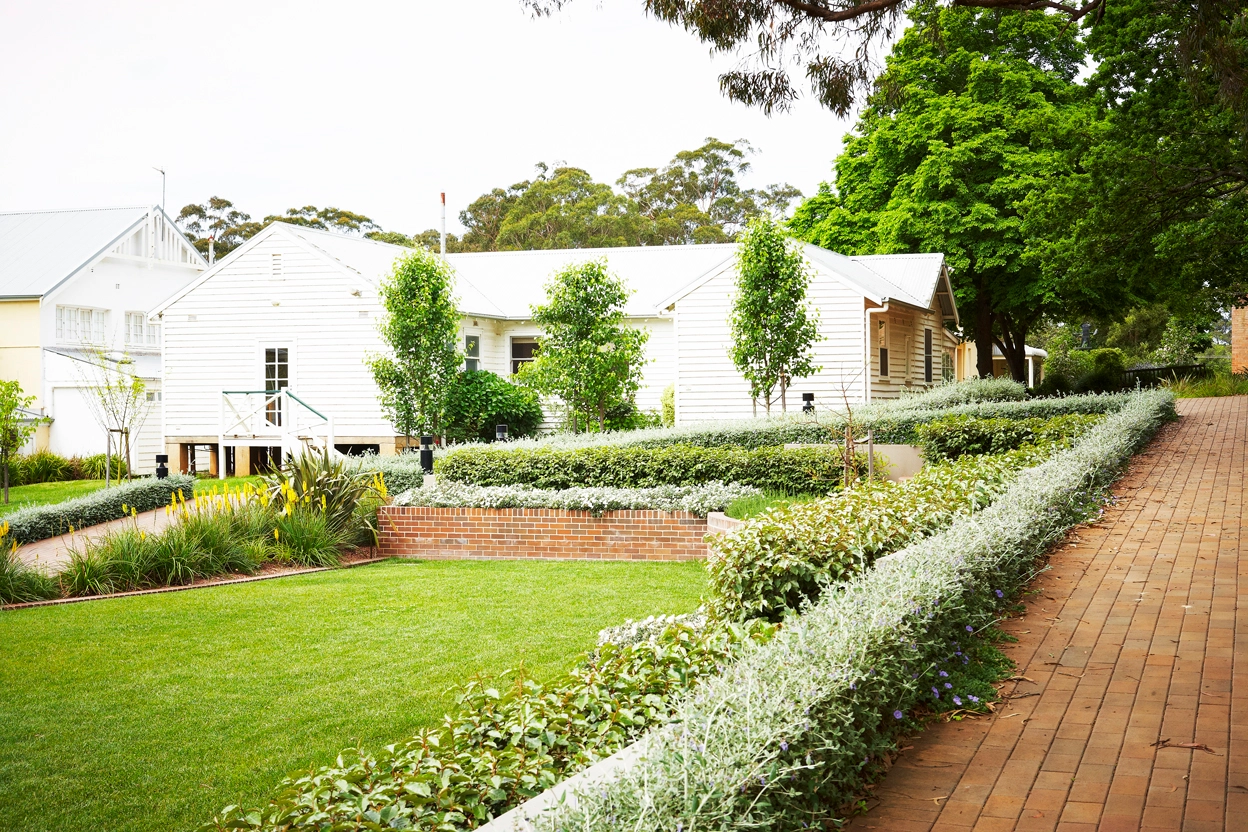
Drainage is the design variable most likely to cause long-term failure when ignored. Waterlogged soils kill plants, accelerate fungal disease, and undermine adjacent hardscape. Identifying and resolving drainage conditions before construction begins is far less costly than remediation after planting.
Improving drainage
- Raised planting areas: Effective for clay-heavy soils. Raising the planting level 200 to 300mm above compacted subsoil significantly improves root zone drainage and plant health.
- Drainage swales: Shallow planted channels that redirect surface water away from planting zones. Melaleuca and sedge species planted along swale edges tolerate periodic inundation and integrate naturally into the landscape composition.
- Subsoil drainage: Where water consistently ponds, ag-pipe drainage below grade can redirect excess moisture to a legal point of discharge. This is best specified at the design stage and coordinated with other site works.
- Soil amendment: Coarse sand and gypsum improve clay structure; compost and organic matter improve water retention in sandy soils. Avoid over-amendment in native plantings, as many Australian species are adapted to lean, low-nutrient conditions.
Fertiliser caution with native plants
Most Australian native plants are adapted to low-phosphorus soils. Standard garden fertilisers can cause serious damage to Proteaceae species, including Banksia, Grevillea, and Hakea. If fertilising is warranted, use a native-specific, low-phosphorus formulation only, and apply sparingly.
Mulching: The Highest-Impact Maintenance Reduction Decision
Mulch does more work per square metre than almost any other element in a low-maintenance native garden. Applied correctly, it addresses weed suppression, moisture retention, soil health, and temperature regulation simultaneously, which is why it belongs in the design specification, not as an afterthought.
A 75 to 100mm layer of coarse organic mulch across all open soil surfaces delivers several compounding benefits:
- Weed suppression: Mulch limits light from reaching weed seeds in the soil. A consistent, even layer across garden beds eliminates the majority of ongoing weeding.
- Moisture retention: Reduced surface evaporation extends the interval between watering, particularly valuable across Sydney and Brisbane summers and during water restriction periods.
- Soil temperature regulation: Root zones are buffered against temperature extremes, which is critical during the first summer of establishment for newly planted species.
- Soil improvement: As organic mulch breaks down, it improves soil structure, supports beneficial microbial activity, and gradually builds topsoil depth.
Specify coarse bark chip or wood chip mulch rather than fine mulch. Fine mulch compacts into a surface layer that repels water rather than absorbing it. Mulch should be kept 50 to 80mm clear of plant stems to prevent crown rot.
Irrigation Planning: What the Landscape Design Should Specify
Established Australian native gardens require minimal supplemental watering. However, the establishment period, typically the first two summers, and extended drought intervals require irrigation. What the landscape design specifies for irrigation has a significant bearing on long-term water use and plant performance.
Drip versus overhead irrigation
Drip irrigation, which delivers water directly to the root zone, is the appropriate specification for most native garden beds. It reduces water waste, avoids wetting foliage (which can promote fungal disease in certain species), and can be programmed to operate in the early morning when evaporation is lowest.
Overhead spray systems suit large open groundcover areas but are less efficient and less targeted. A landscape design should specify the appropriate system type for each zone, informed by the species planted and the water regime required during establishment.
Designing for reduced irrigation over time
The design intent for a low-maintenance native garden is progressive self-sufficiency. Reducing irrigation incrementally after the first two growing seasons encourages deeper root development and drought resilience. A good planting design anticipates this trajectory and species are selected accordingly, not just for immediate establishment.
Native Garden Design for Small Spaces and Courtyards
A constrained footprint does not limit the quality or character of an Australian native garden. It shifts the design emphasis toward species selection and spatial layering. A small courtyard or urban garden designed with the same rigour as a larger property can be equally rich and significantly lower maintenance than a traditional planted space.
Design strategies for small garden spaces
- Compact and dwarf cultivars: Many popular native species have been developed in forms suited to smaller garden spaces. Compact Grevillea varieties, dwarf Westringia, and smaller Callistemon cultivars bring the same planting character in a reduced footprint.
- Vertical planting: In narrow courtyards, tall columnar species or native climbers maximise planting without consuming ground area. Pandorea pandorana on landscape screens or garden structures is an effective example.
- Potted natives: Species such as Kangaroo Paw, compact Correa, and small Lomandra cultivars perform well in containers, making them suitable for courtyard gardens where in-ground planting is limited.
- Groundcovers as lawn alternatives: Native groundcovers replace lawn in small spaces entirely. This removes mowing and significantly reduces water demand. The same substitution works at the front of a house, where a groundcover plane reads as more considered than turf. Myoporum parvifolium, Scaevola, and Viola hederacea are reliable low-maintenance options.

Ecological Value: Native Birds, Bees, and Biodiversity
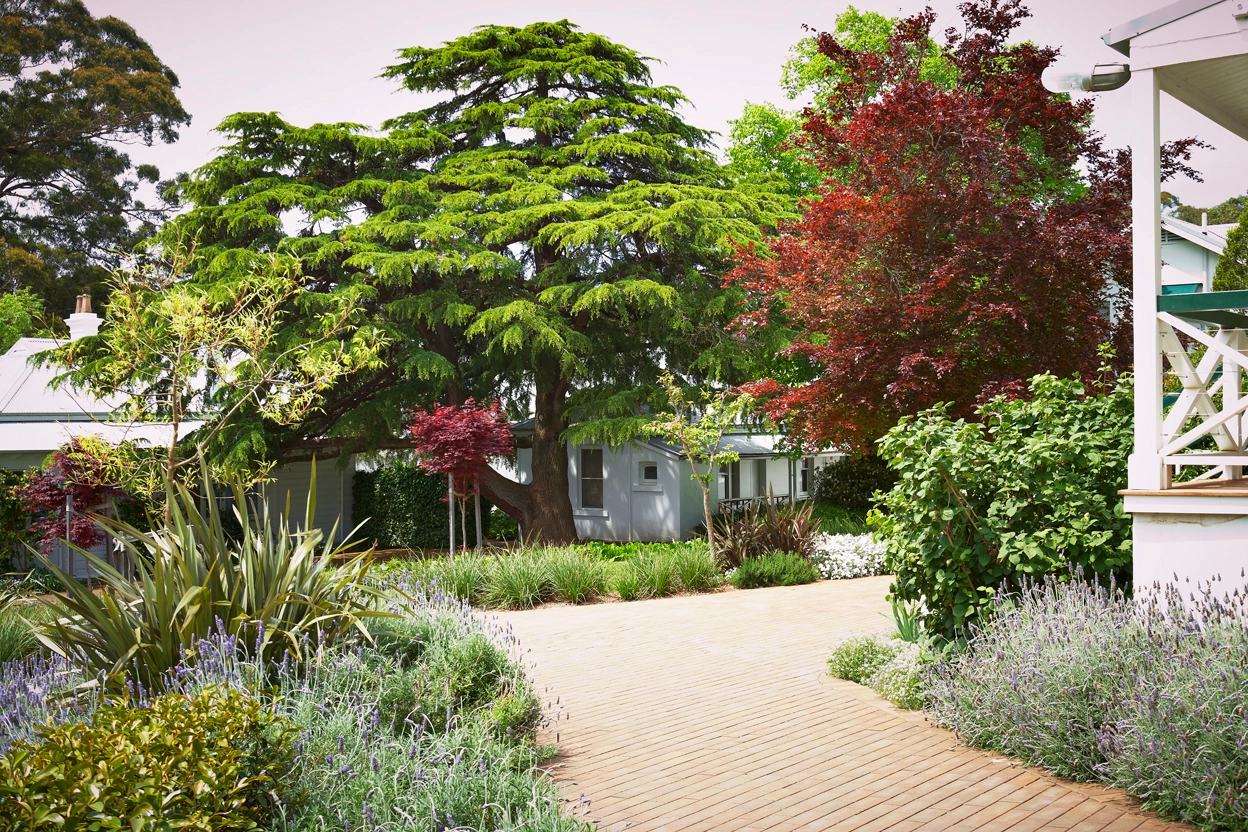
A well-planted native garden functions ecologically, not just aesthetically. It provides food and shelter for local species that depend on Australian native plants to complete their lifecycle.
Flowering species such as Grevillea, Callistemon, and Banksia are significant nectar sources for honeyeaters, lorikeets, and native bees. Dense shrub layers provide nesting habitat. Groundcovers and leaf litter zones support insects and lizards that in turn sustain higher-order species.
This ecological function has a direct practical benefit. A garden supporting a diverse insect community has natural pest regulation built in. Established native plantings that attract predatory insects are inherently more resistant to pest damage than gardens relying on chemical intervention.
For Sydney, Northern Beaches, and South East Queensland properties, incorporating locally occurring native species alongside cultivated varieties increases ecological value substantially. The appropriate species for your specific locality can be confirmed during a site consultation.
Ongoing Maintenance: What a Low-Maintenance Native Garden Actually Requires
Low maintenance is not zero maintenance. Understanding what ongoing care a well-designed native garden requires allows for realistic planning and avoids the neglect that undermines even the most carefully established plantings.
| Task | Frequency | Notes |
|---|---|---|
| Watering (established garden) | Rarely, during extended dry periods | Deep, infrequent watering is better than light, frequent watering |
| Pruning | Once or twice per year, after flowering | Light tip pruning encourages density; avoid cutting into old wood on most species |
| Mulch top-up | Every 12 to 18 months | Maintain 75mm depth; replenish as organic mulch breaks down |
| Weed removal | First 12 months, then occasionally | Primarily during establishment; mulch suppresses most ongoing weed pressure |
| Fertilising | Once per year at most, if at all | Use native-specific, low-phosphorus products only |
| Pest monitoring | Seasonally | Most established natives have strong pest and disease resistance; monitor rather than spray |
The most intensive period for any native garden is the first twelve months. Root systems are establishing, weed competition is highest, and supplemental watering is necessary. After this period, the maintenance workload reduces considerably.
Working with Nicholas Bray Landscapes
Designing a native garden that performs well over the long term requires more than a plant list. It requires an understanding of the site, the soil, the drainage, the local climate, and how the planting composition will evolve as species reach maturity.
Nicholas Bray Landscapes is a registered landscape architecture practice operating across Australia. If you are planning a native garden and want design advice grounded in genuine site knowledge and horticultural expertise, contact Nicholas Bray Landscapes to discuss your project.
Frequently Asked Questions
How long does it take for a native garden to become truly low maintenance?
Most native gardens reach low-maintenance status after two growing seasons. The first summer is the most labour-intensive period, particularly for watering and weed management. Once plants are established and the mulch layer is performing correctly, ongoing workload drops substantially.
Can I design a low-maintenance native garden in a small backyard or courtyard?
Yes. Small spaces suit compact native species and groundcover plantings particularly well. Eliminating lawn and replacing it with groundcovers, mulched beds, and potted natives can reduce weekly maintenance to a seasonal task.
Do Australian native plants need fertiliser?
Most do not. Many native species, particularly Proteaceae such as Banksia and Grevillea, are sensitive to phosphorus and can be damaged or killed by standard garden fertilisers. If fertilising is warranted, use a product formulated specifically for Australian native plants.
What is the best mulch for a native garden?
Coarse bark chip or wood chip mulch at 75 to 100mm depth is the most effective option. Fine mulch compacts into a surface layer that repels water. Keep mulch clear of plant stems to avoid crown rot.
How do I deal with weeds in a native garden?
Mulching is the primary control strategy. A deep, even mulch layer prevents most weed seed germination. Weeds are most persistent during the establishment phase. Once the groundcover layer fills in, weed pressure reduces significantly.
Will native plants survive frost in the Southern Highlands?
Many will. Lomandra, Westringia, most Grevillea cultivars, and a range of Callistemon species are frost-hardy. Plant selection for Southern Highlands and Southern Tablelands gardens must account for frost. A landscape architect familiar with the region can identify appropriate species for your specific site and altitude.
Can Australian native plants grow in clay soil?
Yes, and several species actively prefer it. Melaleuca, Lomandra, and many sedge species tolerate clay well. Drainage still needs to be addressed in heavy clay; raised planting areas or subsoil drainage are often worth specifying before planting.
Do I need council approval for a native garden?
Most residential garden works do not require a Development Application. However, removal of significant trees, earthworks above certain volumes, or drainage works that may affect neighbouring properties can trigger council requirements. A landscape architect can advise on what applies to your specific site and local planning controls.
Should I use local provenance native plants?
Where possible, yes. Local provenance species, grown from seed collected within your specific locality, are best adapted to local conditions and provide the highest ecological value. For ornamental applications, cultivated varieties are appropriate. Mixing locally sourced species into the palette adds genuine ecological function alongside the design intent.
Planning your garden?
Talk to Nicholas Bray about your property.
Tell us a little about your site and what you have in mind, and we’ll be in touch to arrange a consultation.
Prefer to talk? Call 0417 278 267

About the author
Nicholas Bray, Registered Landscape Architect (RILA 958, AILA)
Nicholas Bray is the principal of Nicholas Bray Landscapes, a landscape architecture and construction business based in Moss Vale in the Southern Highlands. With 25 years of experience across landscape architecture, horticulture and environmental planning, he designs and builds gardens for large acreage estates, rural properties, vineyards, schools and commercial sites throughout the Southern Highlands, Central and Southern New South Wales.
Nicholas studied landscape architecture in Australia and Canada, and horticulture at the Royal Horticultural Society’s garden at Wisley in the United Kingdom. He has worked at the Hanbury Botanical Gardens in La Mortola, Italy, and completed projects in Spain, the United Kingdom, Singapore and Canada.
His work balances the built and natural environments with site specific planting, stonework, pools and water features, and he is well known for guiding complex landscape plans through council approval.