


Your Hamptons-style home deserves a garden that completes the picture, not one that contradicts it. The coastal elegance, clean lines and neutral colour palette that define the Hamptons look inside must carry through every outdoor space, from the front fence to the rear entertaining area. This guide draws on over 25 years of landscape architecture practice to walk you through what genuinely works: the right hardscape materials, plant choices that survive the Australian climate, and how to design outdoor spaces that feel cohesive, timeless and liveable.
What Defines a Hamptons-Style Garden
A Hamptons garden is not simply a coastal garden with white furniture. It sits between the formal tradition of European garden design and the relaxed, breezy quality of seaside living. The result is structured without being rigid, lush without being unruly. If you’re into French provincial architecture, check out our French provincial home ideas guide.
| Design Quality | What It Means in Practice |
| Ordered symmetry | Garden beds, paving and lawn areas are deliberately arranged. Uniformity anchors the whole composition. |
| Restrained colour palette | Whites, off-whites, soft greys and muted blues carry the scheme. Colour comes from planting, not from furnishings or feature walls. |
| Natural materials | Timber, sandstone, travertine and stone throughout. No shiny concrete, glazed tiles or synthetic surfaces. |
| Manicured softscape | Dense hedging, clipped topiaries and mass plantings of flowering species provide structure and softness in equal measure. |
| Integrated outdoor living | Deck, entertaining area, lawn and garden read as one continuous space rather than disconnected zones. |
Read the Site Before You Choose Anything
Every successful Hamptons garden starts with site analysis, not a mood board. Your property has specific conditions that will determine which plants thrive, where hardscape performs best, and how to connect the garden to your home without it feeling grafted on.
Orientation and sun movement
This determines where the lawn performs well, where hydrangeas can be protected from harsh afternoon sun, and where to position your entertaining area for comfortable use through the day.
Drainage and stormwater
Poor drainage beneath a beautifully paved terrace is a long-term failure. Address it at design stage, before any hardscape is installed.
Your home’s architecture
The cladding material, roof pitch, window trims and verandah joinery are the starting point for every landscape decision. A Hamptons garden that does not reference the building it serves will always look disconnected, regardless of quality.
Climate and soil
Whether your property is on the NSW coast, in the Southern Highlands, or inland suburban, the local climate shapes every planting decision. Many traditional Hamptons species need meaningful adaptation for Australian conditions.
Privacy and outlook
Identify what needs to be screened and what deserves to be left open. These are site-specific judgements that no generic plant list can answer for you.
The Hamptons Colour Palette Applied Outdoors
The palette that works inside a Hamptons home translates directly outdoors, with one rule: every surface in the garden should be consistent in tone. When the palette fragments across fence, paving, deck and furniture, the cohesive quality that defines the style is lost.
Hardscape and structure colours
- Paving: warm white, off-white, light sandstone, or pale grey rectangular formats
- Decking: whitewashed, lightly stained, or naturally weathering hardwood
- Fencing and gates: crisp white painted timber, or natural weathered grey
- Pergola and built structures: white or off-white painted hardwood
Soft furnishings and accent touches
- Outdoor cushions and textiles: white, linen, pale grey, soft navy, or sage
- Pots and planters: white, neutral stone, or terracotta washed back to a muted tone
- Lighting fixtures: aged brass, matte black, or classic lantern finishes
Where planting delivers the colour
In a Hamptons garden, the planting palette carries most of the visual interest. Blues and purples from hydrangeas and agapanthus, deep glossy greens from clipped hedges, silver grey from olive foliage and coastal rosemary. These tones support the architecture rather than compete with it.
Hardscape: Paving, Decking, Fencing and Built Structures
The hardscape forms the bones of your garden and the most expensive elements to change, so material selection needs careful thought from the outset, not as a late budget exercise.
Paving
Travertine, sandstone, and light reconstituted stone pavers in rectangular formats are the most appropriate choices. Laid in a stretcher bond or simple grid, they reinforce the ordered character the style requires. Avoid dark, glossy, or busy-textured surfaces, all of which conflict with the relaxed coastal tone.
Decking
Hardwood decking in wider boards suits the Hamptons scale. Boards that weather to a soft grey, or that are whitewashed and maintained, both work. A wide, white-railed deck reads as a direct extension of the home’s verandah and is one of the most recognisable elements of the Hamptons outdoor aesthetic.
Fencing and gates
The fence frames the entire property before anyone enters the garden. White painted timber picket, horizontal timber slats in white or grey, or well-proportioned aluminium alternatives all suit the style. The fence must feel generous in scale, well maintained, and visually aligned with the home’s trim colours.
Pergolas and outdoor structures
- White-painted hardwood pergolas over the entertaining area establish the outdoor room
- Open beam construction keeps the structure light and airy, not oppressive
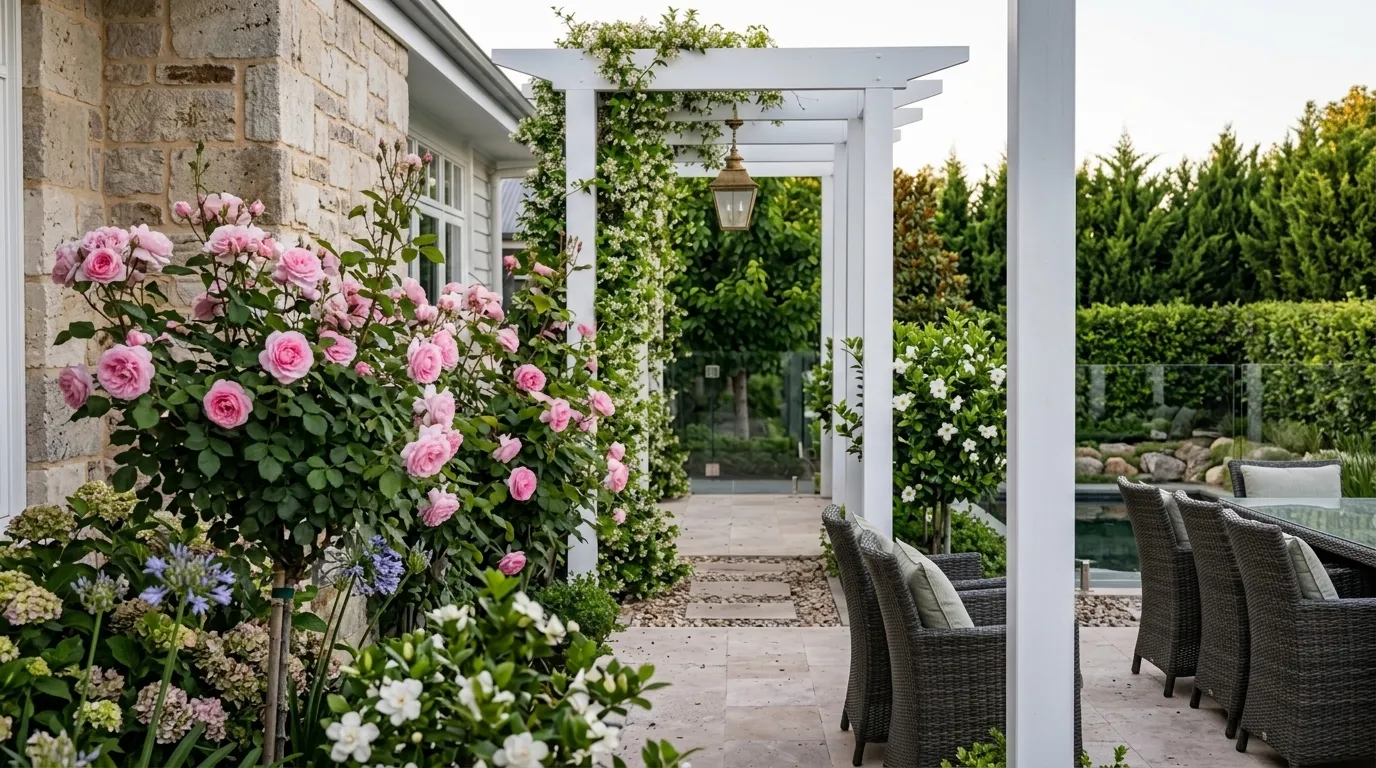
- Climbing plants including roses, wisteria or star jasmine soften the structure over time
- Arbours framing pathways or gate entries add depth and layering to the garden composition
Retaining walls and edging
Sandstone is a natural companion to Hamptons cladding materials and reads as genuinely Australian within the style. Formal lawn edging between turf and planting beds is non-negotiable for maintaining the manicured quality the style demands.
Plant Selection: The Softscape That Makes It Work
This is where many Hamptons gardens fall short in Australia. The species most associated with the style are predominantly temperate-climate plants and need thoughtful adaptation depending on your location.
Flowering plants
| Plant | Why It Works | Climate Note |
| Hydrangea | The defining Hamptons flower. Blue, white and purple varieties anchor the colour palette. | Needs afternoon shade and consistent moisture in warmer regions. |
| Agapanthus | Hardy, lush green foliage with blue, white or purple flower heads. Excellent for mass plantings. | Highly adaptable across most of Australia. |
| Lavender | Fragrant, grey-green foliage, soft purple flower spikes that sit naturally in the Hamptons palette. | Needs free-draining soil and full sun. |
| Gardenia | White flowering, glossy-leafed and fragrant. Works well close to the house in sheltered positions. | Prefers warmth with protection from frost. |
| Roses | White, blush and pale pink climbing or standard varieties add classic Hamptons romance. | Well suited to the Southern Highlands and cooler coastal regions. |
Hedging and structural plants
- Buxus: The traditional Hamptons hedge, clippable to formal shapes. Monitor for box blight in humid regions of NSW.
- Westringia: A reliable Australian native substitute for Buxus. Hardy, drought tolerant and clips to tight formal shapes. A practical first choice where blight risk is high.
- Viburnum: Fast growing, dense, and responds well to formal shaping across most of eastern Australia.
- Murraya: Fragrant white flowers, glossy foliage, tolerates hard clipping. Works well in warmer climates.
Trees for scale and structure
- Magnolia ‘Little Gem’: Evergreen, compact, white flowering. Well suited to narrow beds along fences or as a single specimen focal point.
- Olive trees: Silver-grey foliage sits naturally in the Hamptons colour palette. Hardy in coastal and semi-arid conditions.
- Ornamental pear: Neat upright form with good autumn colour. Suits the Southern Highlands and cooler regions.
- Silver birch: White-stemmed, delicate-leafed, strongly associated with the Hamptons look. Requires cooler conditions to perform at its best.
Ornamental grasses and ground covers
Fine ornamental grasses introduce gentle movement and textural contrast against the formality of clipped hedging. Native violet (Viola hederacea) threaded between sandstone stepping stones gives a naturalistic quality without disturbing the garden’s overall order.
If you’re interested in more contemporary home designs, see our guide to modern farmhouse design in Australia.
Lawn: The Foundation the Eye Returns To
A manicured lawn gives a Hamptons garden its sense of space and calm. It is the visual anchor around which everything else is arranged, and without it the composition loses its grounding quality.
| Variety | Key Qualities | Best For |
| Sir Walter Buffalo | Excellent shade tolerance, soft underfoot, holds winter colour well | Most residential sites across NSW and coastal regions |
| Sir Grange Zoysia | Fine-leafed, carpet-like finish, very drought tolerant once established | Where a precise, manicured appearance is the priority |
| Kikuyu | Fast growing and hard wearing | High-traffic areas, but requires diligent edging to stay out of beds |
Crisp maintained edging between turf and garden beds is what separates a Hamptons lawn from a general residential lawn. The edge is as important as the grass itself.
Outdoor Living: Designing for How You Actually Use the Space
The Hamptons style supports the way Australians genuinely live outdoors. The key is treating the alfresco, deck, pool area and garden as a connected sequence of spaces, not a collection of separate features placed next to each other.
The alfresco and entertaining area
A generous paved area adjacent to the home is the heart of Hamptons outdoor living. Position it to capture the sun you want through the day, size it to move comfortably around a full dining setting, and frame it with a white-painted pergola. This is where the indoor-outdoor connection begins.
Outdoor furniture
- Teak, powder-coated aluminium, wicker or rattan in white, natural or grey tones
- Adirondack chairs at the lawn edge or poolside are a classic Hamptons detail
- Linen-look outdoor cushions in white, sage, grey or soft navy keep the palette consistent
- Oversized lanterns and aged-brass or matte-black light fittings as accent pieces
Pools in a Hamptons landscape
A rectangular pool design with clean geometry is the appropriate form for this style. Coping in travertine, sandstone or light stone continues the material palette from the paving into the pool zone. In Australia, pool barrier compliance is non-negotiable. Design the fencing into the garden from the very start, not retrofitted into a finished scheme. Frameless glass is the least visually intrusive option. Well-proportioned aluminium in white or matte black can also work within the Hamptons palette when detailed carefully.
Creating multiple outdoor zones
The strongest Hamptons gardens offer more than one place to be: a dining area under the pergola, a lounge zone at the pool edge, an open lawn for children or informal gatherings, and a garden path that connects them all. Each zone serves a purpose and none is purely decorative.
Lighting: Extending the Garden into the Evening
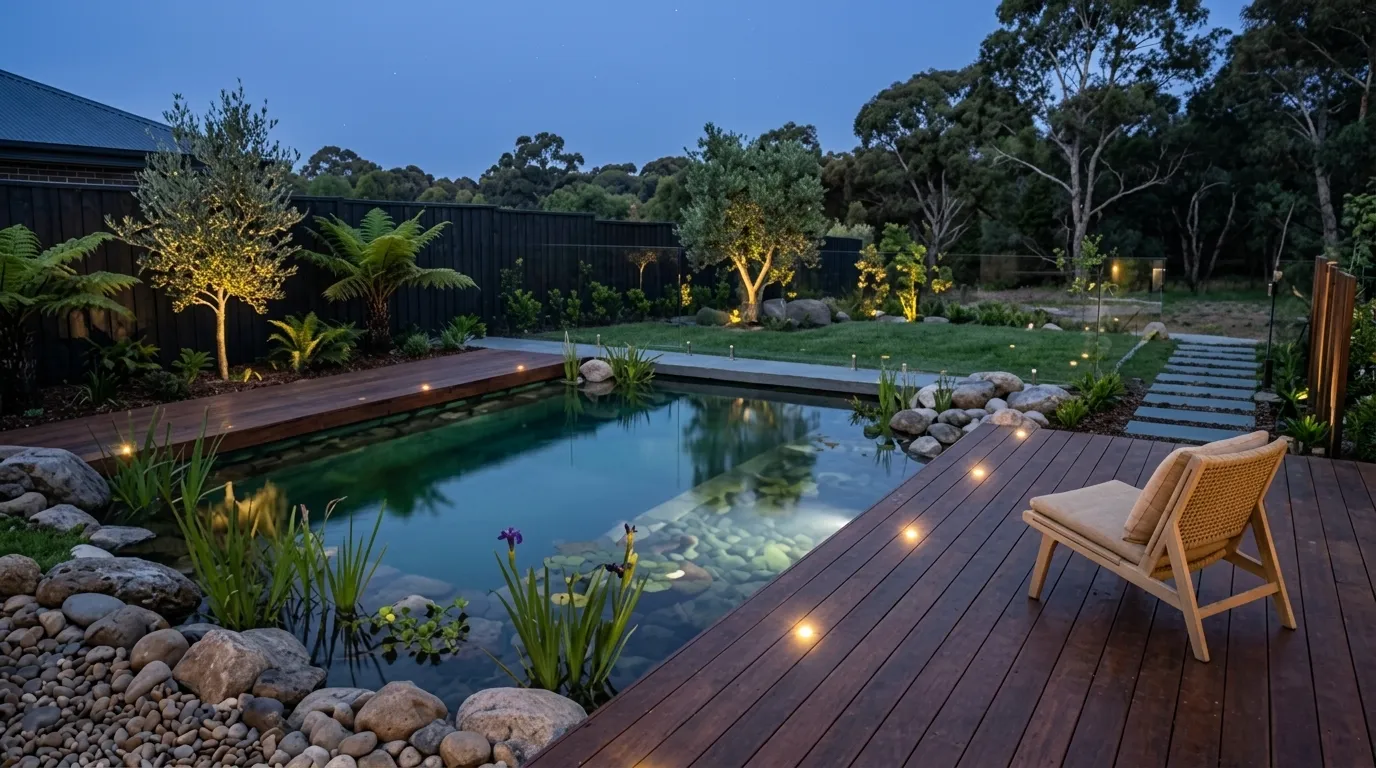
Outdoor lighting in a Hamptons garden should feel warm, considered and quiet. The goal is to extend the garden’s usability after dark while preserving the coastal atmosphere that makes the style appealing.
| Lighting Type | Where It Works Best | Finish to Specify |
| Lantern wall mounts | Gate posts, verandah entry, along the alfresco wall | Aged brass or matte black |
| Low bollard path lights | Garden pathways, lawn edges, steps | Matte black or brushed nickel |
| In-ground up-lighting | Feature trees, stone retaining walls, pergola columns | Concealed fitting, warm white at 2700K |
| Festoon or string lights | Under the pergola, along fence lines at the entertaining area | Warm globe at 2700 to 3000K only |
Cool white or bright floodlighting disrupts the calm, airy feel the style depends on. All outdoor lighting in a Hamptons garden should be warm in tone, never clinical.
Connecting House and Garden: Where Most Projects Go Wrong
The garden should be planned alongside the architecture, not after it. When the landscape is an afterthought, no amount of quality planting or expensive materials fully rescues the disconnect. These are the connection points that matter most.
- Entry paving should reference or complement the flooring material at the home’s threshold
- Fence, gates and external joinery should align in colour with the window trims and verandah balustrade
- The scale of hedging, trees and structural planting should be proportional to the height and mass of the building
- Architectural details on the home, VJ panelling, board and batten profiles, mouldings, can be echoed in pergola joinery and fence detailing
- The front garden entry sequence sets the tone for everything that follows and deserves the same design attention as the rear garden
What Undermines a Hamptons Garden
These are the most consistent errors seen in Hamptons-style landscapes across Australia. Avoiding them is as important as getting the positive decisions right.
Treating the landscape as a budget carryover
When a build runs over budget, the garden is typically the first to be reduced. A Hamptons home with an underfunded landscape simply does not read as Hamptons. The garden carries as much of the architectural intention as the building itself.
Mismatched materials
Dark deck boards against pale sandstone paving, or terracotta roof tiles against an entirely white planting scheme: these combinations fracture the visual cohesion the style depends on. Every material choice needs to be considered in the context of everything else.
Planting before resolving structure
Beautiful plants in the wrong positions, blocking views, overwhelming scale, casting unwanted shade, create long-term problems that maintenance alone cannot solve. Structure and layout come first and planting fills it.
Ignoring the front garden
The street frontage and entry sequence form the first impression of the entire property. A Hamptons home with a neglected or mismatched front garden loses the aesthetic before anyone reaches the front door.
Choosing plants for looks over climate suitability
Hydrangeas need consistent moisture and afternoon shade protection in warmer climates. Buxus requires monitoring for blight in humid conditions. The Hamptons look depends on plants being healthy and full. A climate-appropriate substitute that thrives always outperforms a faithful species that struggles.
Getting the Garden Right from the Start
A Hamptons-style garden is more than a selection of plants and materials. It is a carefully planned extension of the home, where every element works together. The best results come from designing the home’s landscape alongside the architecture, creating a timeless outdoor space that looks beautiful from day one and continues to mature gracefully.
If you’re planning a Hamptons-style home in the Southern Highlands or across NSW, Nicholas Bray Landscapes can help bring your vision to life. With over 25 years of experience in residential landscape architecture, horticulture, and environmental planning, we create landscapes that complement exceptional homes.
Every project begins with a site consultation. Get in touch to arrange one.
Frequently Asked Questions
What plants best suit a Hamptons-style garden in Australia?
Hydrangeas, agapanthus, lavender, gardenias and roses are the most reliable flowering choices. For hedging, Westringia and Viburnum perform well across most of eastern Australia, with Buxus suited to drier or cooler conditions. Magnolia ‘Little Gem’ and olive trees are the go-to structural tree choices. Plant selection should always be tested against your specific local climate, particularly summer heat, rainfall patterns and soil conditions.
Which paving material works best in a Hamptons garden?
Travertine and sandstone are the most appropriate choices. Both carry the warm neutral tones that define the palette and age well in Australian outdoor conditions. Lay pavers in a rectangular format using a stretcher bond or simple grid. Avoid dark, glossy or heavily textured surfaces, all of which conflict with the coastal tone the style depends on.
Do I need a landscape architect for a Hamptons-style garden?
For a flat site with a straightforward brief and no significant construction, a skilled landscape designer can deliver a solid result. For projects involving significant level changes, pools, retaining structures, council development application requirements or construction certificate documentation, a qualified landscape architect provides the design resolution, technical drawings and site management the project needs.
What fence colour suits a Hamptons-style home?
White or off-white painted timber is the most faithful choice and should align with the home’s window trims and verandah joinery. Horizontal timber slats in a similar tone give a slightly more contemporary result. Colorbond in non-neutral tones reads as too industrial for the Hamptons aesthetic and should be avoided at the street frontage.
Can I achieve the Hamptons look without a pool?
Yes. A pool is one possible feature, not a defining requirement. The Hamptons look is achieved through the overall composition: lawn, manicured hedging, structured planting, natural materials and a well-resolved entertaining space. Many excellent Hamptons-style gardens in Australia work without a pool, particularly on smaller suburban blocks where the budget is better directed toward quality hardscape and planting.
How do I adapt a Hamptons garden for a hot Australian climate?
Prioritise climate-appropriate substitutes where needed. Use Westringia in place of Buxus in humid or hot regions, position hydrangeas where they receive afternoon shade and consistent irrigation, and select turf varieties suited to your local conditions. Design pergolas and shade structures to protect heat-sensitive planting from afternoon exposure. A plant that thrives in your climate will always deliver a better result than a faithful species that struggles.
What turf variety suits a Hamptons-style garden?
Sir Walter Buffalo and Sir Grange Zoysia are the two most appropriate varieties. Sir Walter handles shade well and maintains colour through winter. Zoysia delivers a finer, carpet-like finish and is highly drought tolerant once established. Whichever is used, crisp maintained edging between lawn and garden beds is essential. The edge defines the quality of the lawn as much as the grass itself.
How do I handle pool fencing without disrupting the Hamptons aesthetic?
Design the pool barrier into the garden layout from the start of the project, not as a retrofit around a finished scheme. Frameless glass is the least visually intrusive option and allows pool and planting to read as one uninterrupted space. Well-proportioned aluminium balustrades in white or matte black can also work within the palette when scaled and positioned carefully.
What outdoor furniture works in a Hamptons garden?
Teak, powder-coated aluminium, wicker and rattan in neutral tones work consistently well. Adirondack chairs at the lawn or pool edge are a classic Hamptons detail. Layer outdoor cushions and textiles in linen-look fabrics in white, grey, soft navy, or sage. Avoid bright colours, overly contemporary forms and plastic furniture, all of which sit outside the Hamptons palette and character.
Planning your garden?
Talk to Nicholas Bray about your property.
Tell us a little about your site and what you have in mind, and we’ll be in touch to arrange a consultation.
Prefer to talk? Call 0417 278 267

About the author
Nicholas Bray, Registered Landscape Architect (RILA 958, AILA)
Nicholas Bray is the principal of Nicholas Bray Landscapes, a landscape architecture and construction business based in Moss Vale in the Southern Highlands. With 25 years of experience across landscape architecture, horticulture and environmental planning, he designs and builds gardens for large acreage estates, rural properties, vineyards, schools and commercial sites throughout the Southern Highlands, Central and Southern New South Wales.
Nicholas studied landscape architecture in Australia and Canada, and horticulture at the Royal Horticultural Society’s garden at Wisley in the United Kingdom. He has worked at the Hanbury Botanical Gardens in La Mortola, Italy, and completed projects in Spain, the United Kingdom, Singapore and Canada.
His work balances the built and natural environments with site specific planting, stonework, pools and water features, and he is well known for guiding complex landscape plans through council approval.