


The English cottage garden is one of the most requested styles for country properties in the Southern Highlands, and with good reason. Cool winters, reliable rainfall and long spring seasons give this region conditions closer to rural England than almost anywhere else on the continent. The challenge is knowing which elements travel well, which need adjusting, and how to compose a plan that holds together over decades, not just seasons.
What makes an English cottage garden distinct
An English cottage garden is not simply a garden that looks full. It is a layered, informal composition built on a structured framework of hedges, paths and vertical elements, with generous planting allowed to spill and self-seed within that framework. The informality is deliberate, not accidental.
Three qualities define the style:
- Density: bare soil is rarely visible; plants are layered from ground cover to climber
- Fragrance: scented species anchor the planting in every season
- Productive elements: herbs, cutting flowers and edibles are woven through the ornamental beds rather than separated from them
In England, this combination evolved from necessity. Cottage dwellers needed food, medicine and beauty from the same piece of ground. That practical logic translates directly to Australian acreage, where a productive, fragrant garden that also looks settled is far more valuable than a purely ornamental one. In warmer regions, tropical garden design ideas may offer a more climate-suited direction than trying to reproduce a cool-climate cottage palette.
Why the Southern Highlands suits this style
Most Australian climates force a compromise with the traditional English model. In the Southern Highlands, that compromise is smaller than people expect. The plateau sits between 700 and 900 metres above sea level, giving it genuine cold winters, real frosts from late April through to September and a summer dry period that is mild by Australian standards.
These conditions are not a problem for the cottage garden style. They are an advantage. The plants most associated with the English cottage garden, including delphiniums, foxgloves, sweet peas, hollyhocks and climbing roses, need cold dormancy to perform. Properties in Moss Vale, Burradoo, Sutton Forest and the surrounding villages can grow the authentic palette rather than the heat-tolerant substitutes that gardeners in Sydney or Brisbane are forced to rely on.
What the Highlands requires is attention to two site-specific realities: cold air drainage and wind exposure. Cold air pools in low-lying areas, which can extend frost periods well beyond what the calendar suggests. And the prevailing westerlies across open paddock land can desiccate even frost-hardy plants. Site analysis before planting addresses both. For the area near a street-facing entrance, low-maintenance front yard native garden ideas can provide a practical approach beyond the more intensive cottage beds.
The plan before the planting
The most common mistake in adapting an English cottage garden to Australian conditions is treating it as a planting exercise. It is a design exercise first. The planting comes after the structure is decided.
Before a single plant goes into the ground, a well-considered cottage garden plan addresses:
- How the garden connects to the house: which rooms does it serve, where are the entry points, what does the garden need to do from inside the building
- The scale of the planted area relative to the property: on acreage, a cottage garden of one or two acres kept in high intensity is more achievable than five acres managed loosely
- The boundary and enclosure: a picket fence, a low stone wall or a clipped hedge gives the informal planting something to push against, which is part of what makes the style work
- The path system: paths in a cottage garden are not just practical; they determine how the garden is experienced from within, and they need to be wide enough for plants to spill without becoming impassable
- Drainage: the same clay soils that hold moisture for lavender and roses can waterlog if drainage is not managed; swales, raised beds and gravel paths all play a role
A landscape architect working through these decisions produces a set of drawings that tells every trade exactly what to build and every planter exactly what goes where. That documentation is what separates a settled garden that reads as planned from one that looks like a collection of plants.
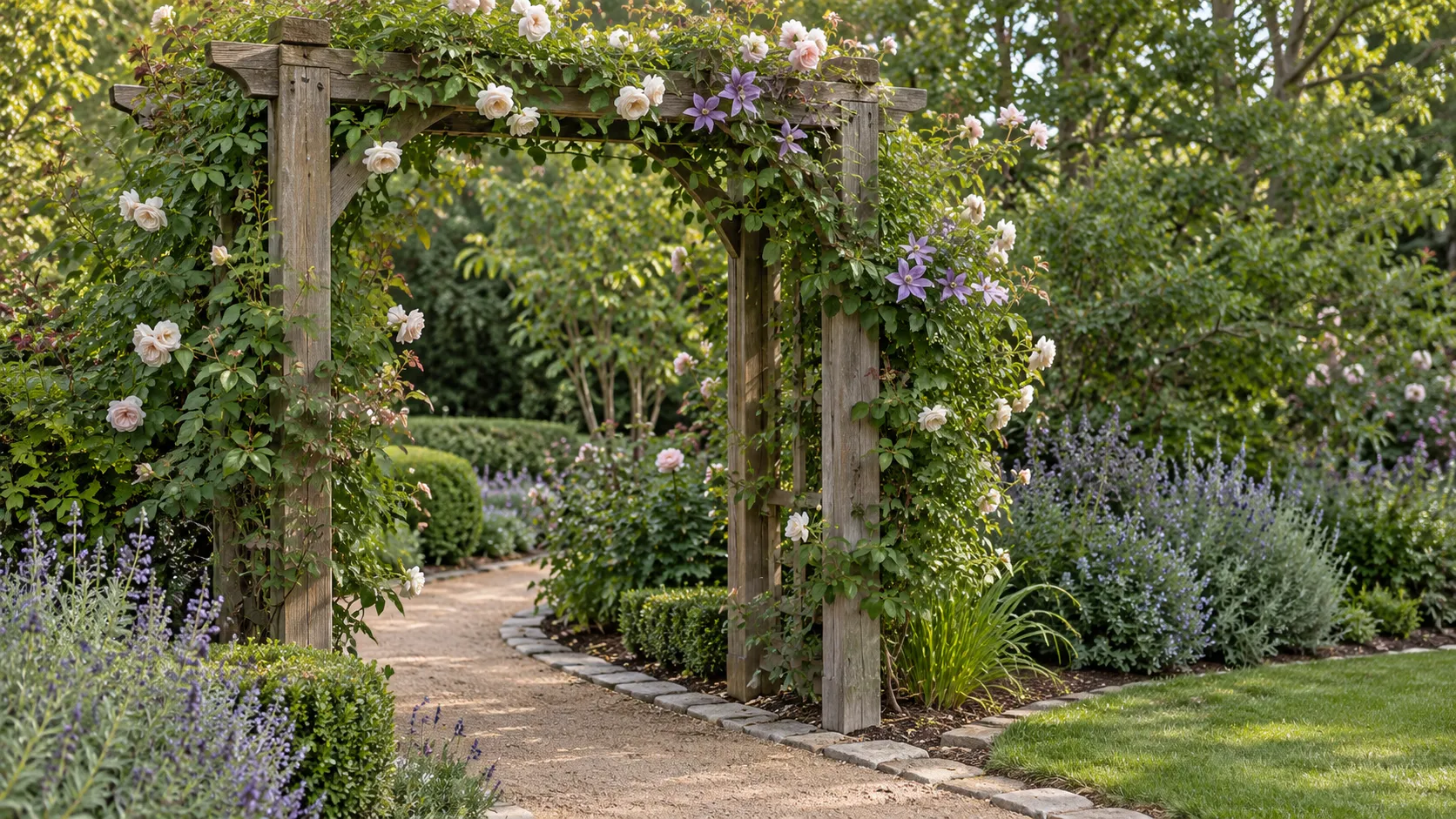
Plants that genuinely perform in cool-climate NSW
The following plants form the backbone of an authentic English cottage garden in the Southern Highlands. They are selected not for their English pedigree alone but because they perform reliably in cool-climate conditions, tolerate real frosts and are honest about their maintenance requirements.
| Plant | Why it works in cool-climate NSW | Role in the garden |
|---|---|---|
| English lavender (Lavandula angustifolia) | Handles genuine winter cold and summer drought once established | Border edging, fragrant ground cover, pollinator magnet |
| Fox glove (Digitalis purpurea) | Self-seeds freely in cool, moist conditions; thrives in part shade | Vertical accent, cottage character, attracts bees |
| Delphinium (Delphinium elatum) | Needs cold winters to perform; the Highlands delivers exactly that | Dramatic back-of-border spike, classic English palette |
| Sweet pea (Lathyrus odoratus) | Fragrant annual; sow in autumn in cool climates for spring bloom | Climber over fences and arches, scent and colour |
| Hollyhock (Alcea rosea) | Biennial that self-seeds; tolerates frost and established dry spells | Tall vertical character against walls and fences |
| Climbing rose (Rosa) | Old varieties such as Cecile Brunner tolerate cold winters and need them to set bud | Archways, pergolas, boundary fences |
| Catmint (Nepeta x faassenii) | Drought-tolerant, frost-hardy; long flowering period through summer | Soft grey-blue edging, spills naturally onto paths |
| Hydrangea (Hydrangea macrophylla) | Needs cold to set flower buds; performs reliably in Southern Highlands winters | Massed shrub planting, shade areas, cottage structure |
| Clematis (Clematis montana) | Vigorous in cold climates; requires cold dormancy period for spring flush | Scrambles through trees, over pergolas and boundary structures |
| Cosmos (Cosmos bipinnatus) | Annual; sow in spring; self-seeds reliably once established | Airy mid-border filler, long summer to autumn flowering |
One note on species not listed above: some classic English cottage plants, including delphiniums and foxgloves, are less reliable in the warmer parts of the state. If a site sits below 600 metres in elevation, the planting scheme needs adjustment. The soil and site analysis that precedes a landscape plan identifies this early, before money is spent on plants that will not deliver.
For more detail on choosing and combining species, see the cottage garden plants guide.
Adapting the design elements for Australian conditions
The aesthetic components of an English cottage garden translate to Australia with adjustment, not wholesale replacement. The comparison below shows how each element is typically handled on an Australian country property.
| Design element | English original | Australian adaptation |
|---|---|---|
| Boundary treatment | Picket fence or dry stone wall | Timber post-and-rail, sandstone, or recycled brick to suit site character |
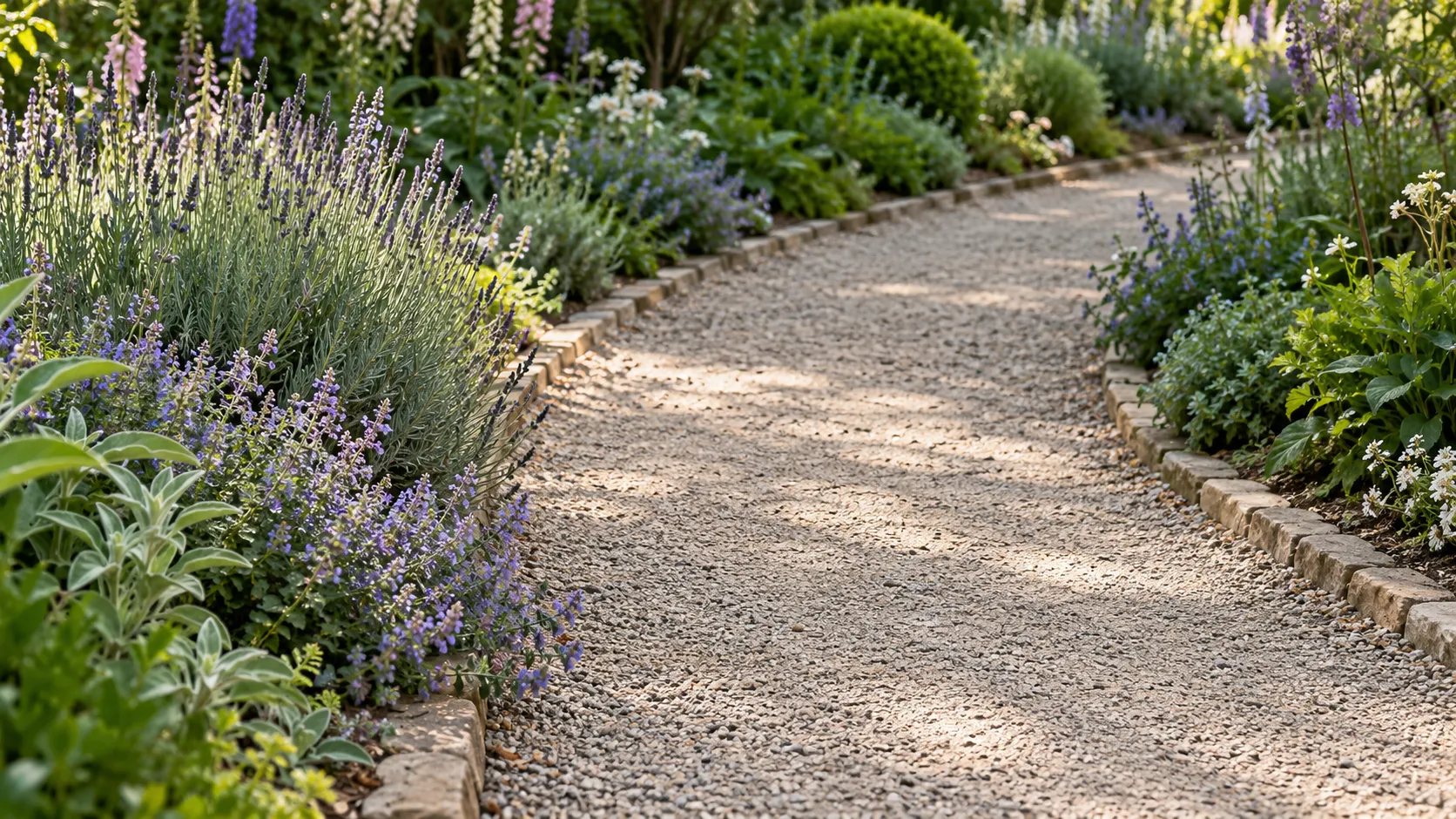
| Path material | Gravel, brick or flagstone | Sandstone or decomposed granite; local stone where it reads naturally on site |
| Backbone planting | Box hedging (Buxus sempervirens) | English box in cool climates; Westringia or Murraya in warmer zones to avoid blight risk |
| Climbing frame | Timber pergola or iron archway | Hardwood or treated pine; corten steel suits a contemporary country house |
| Water feature | Stone birdbath or formal rill | Stone birdbath or simple tank overflow; low maintenance, no pumps exposed to frost |
| Productive element | Kitchen garden within the ornamental beds | Raised beds in hardwood or corten; separates productive from ornamental on acreage |
One element worth singling out is the box hedge.
English box (Buxus sempervirens) is the traditional edging plant of cottage garden paths and beds. In cool-climate NSW it performs well, and its need for cold winters actually suits the Highlands. Box blight is now a genuine concern across Australia, so any planting programme that relies heavily on Buxus should include a disease management approach. Where a client prefers to avoid the risk, Westringia fruticosa ‘Wynabbie Gem’ provides a similar clipped form with a native species that is fully frost-hardy.
The self-seeding principle: how cottage gardens manage themselves
One of the least discussed advantages of the cottage garden style is the way it reduces maintenance load over time. In a well-planted cottage garden, species like foxglove, cosmos, hollyhock and sweet pea self-seed reliably, filling gaps and refreshing the planting each season without replanting effort.
This is not a happy accident. It is a designed outcome. It requires:
- Species selection: choosing reliably self-seeding annuals and biennials alongside perennial structure
- Restraint in mulching: heavy mulch applied to bare soil prevents seed germination; cottage gardens are best mulched lightly or left to develop a natural leaf layer between plants
- Editing rather than replanting: each season involves thinning and editing the self-seeded plants, not ripping out and starting again
On a country property managed by a grounds team rather than the owners themselves, this approach needs to be captured in a maintenance schedule, which is a document the practice prepares as part of design documentation. Without it, a grounds team will often over-mulch and over-tidy, undoing the self-seeding cycle within one season.
Scale and structure on acreage
Acreage introduces a question that smaller suburban gardens do not face: where does the cottage garden stop? The style works best when it is contained and intensive near the house, with a clear transition to paddock or extensive planting beyond.
On a two-hectare property with a homestead, a well-scaled cottage garden occupies the area immediately around the house and along key arrival paths. Beyond that zone, the planting shifts to shelter belts, orchard rows or managed grassland. The edge between intensive garden and extensive landscape is as important a design decision as the planting plan itself. This transition is also a central consideration when designing a country garden across the whole property.
Trying to extend cottage-style planting across an entire acreage produces a garden that looks unfinished and cannot be sustained. The grounds needed to mow, deadhead and tend an unbounded cottage garden grow faster than most property owners expect. Defining the boundary early, and being disciplined about holding it, is what keeps the garden manageable across the decades most country properties actually occupy.
Focal points and structural elements that hold the design together
The signature of a mature English cottage garden is that it appears unplanned while actually being highly structured. That structure comes from hardscape elements and specimen plants that anchor the composition when the seasonal flowers are finished.
Arches and pergolas
A timber or iron arch draped in climbing roses or clematis gives the eye a destination. It frames views from the house, signals entry to a section of the garden and provides height that herbaceous planting cannot sustain through winter.
Specimen trees
A single crabapple, ornamental cherry or weeping pear provides blossom in spring and structure in every other season. On a country property, a row of fruiting pear espaliers against a fence adds productive value and a strong linear element that holds the cottage beds in place.
Water features
A simple stone birdbath positioned where it draws the eye down a path is a more durable focal point than a complex water feature with pumps and pipework exposed to frost. The cottage garden tradition favours the modest over the elaborate.
Seating areas
A well-placed seat, whether a simple timber bench or a stone plinth, invites the garden to be occupied rather than just observed. Its position should be decided in the plan, not added as an afterthought when the planting is in.
If you are planning a garden for a country property in the Southern Highlands or elsewhere in regional NSW, the decisions that matter most are the ones made before construction begins. Nicholas Bray Landscapes offers site consultations to work through the design opportunities and constraints specific to your property.
Book a consultation with Nicholas Bray Landscapes to discuss your site.
Frequently asked questions
Can an English cottage garden work in a warm Australian climate?
The classic English palette, including delphiniums, foxgloves and climbing roses, requires genuine cold winters to perform well. In warmer parts of Australia, gardeners substitute South African and Mediterranean species that share the layered, informal aesthetic but tolerate heat and summer drought. In the Southern Highlands, the real plants are available; the substitution is rarely necessary.
How much maintenance does a cottage garden require?
A well-planned cottage garden involves significant attention in its first two to three seasons while plants establish and the self-seeding cycle begins. Once established, the maintenance reduces to seasonal editing, light pruning and deadheading rather than replanting. The maintenance schedule a landscape architect produces at the end of a project is the document that makes the handover to a grounds team manageable.
What is the minimum area needed for a cottage garden to read well?
A cottage garden can be effective in a space as small as 50 to 80 square metres if the structure is resolved and the planting is dense. On acreage, the question is more often about limiting the cottage area to what can be maintained intensively, typically the zone within 20 to 30 metres of the house, rather than extending it across the full property.
What is the best path material for an Australian cottage garden?
Local sandstone, decomposed granite or recycled brick all suit the style and are widely available in NSW. The material should read naturally on the site: a property with a sandstone retaining wall already in place benefits from sandstone paths that continue the palette. Width matters as much as material: paths of at least 1.2 metres allow planting to spill without closing the path.
Should I use English box hedging or a native alternative?
English box performs well in cool-climate NSW and suits the style authentically. The risk of box blight is real and increasing across Australia, so any scheme that relies heavily on it should include a management plan. Where a native alternative is preferred, Westringia fruticosa ‘Wynabbie Gem’ provides a similar clipped habit, is fully frost-hardy and requires no special disease management.
When is the right time to start planning a cottage garden on a new property?
The design work should begin before the house is completed, not after. On a country property, some elements, including garden walls, pergola footings and path bases, are best constructed during the build when trades are already on site. Shelter planting for a cottage garden also benefits from being established a full season before the ornamental planting begins.
Does a landscape architect handle both the design and the planting?
Yes. Nicholas Bray Landscapes takes projects from initial site consultation through concept design, construction documentation, council approval management where needed and construction delivery, coordinating specialist trades and planting contractors. The design-and-construct capability means the drawings produced are the same ones built from, which removes the gap that often opens between design intent and what is actually installed.
What council approvals might a cottage garden require on a rural property?
Significant earthworks, retaining walls over a certain height and structures including pergolas and garden sheds may require a Development Application or Construction Certificate through the relevant local council. A landscape architect advises on which elements trigger approval requirements and manages the application process where needed.
Planning your garden?
Talk to Nicholas Bray about your property.
Tell us a little about your site and what you have in mind, and we’ll be in touch to arrange a consultation.
Prefer to talk? Call 0417 278 267

About the author
Nicholas Bray, Registered Landscape Architect (RILA 958, AILA)
Nicholas Bray is the principal of Nicholas Bray Landscapes, a landscape architecture and construction business based in Moss Vale in the Southern Highlands. With 25 years of experience across landscape architecture, horticulture and environmental planning, he designs and builds gardens for large acreage estates, rural properties, vineyards, schools and commercial sites throughout the Southern Highlands, Central and Southern New South Wales.
Nicholas studied landscape architecture in Australia and Canada, and horticulture at the Royal Horticultural Society’s garden at Wisley in the United Kingdom. He has worked at the Hanbury Botanical Gardens in La Mortola, Italy, and completed projects in Spain, the United Kingdom, Singapore and Canada.
His work balances the built and natural environments with site specific planting, stonework, pools and water features, and he is well known for guiding complex landscape plans through council approval.