


Sydney sits south of the tropics, but its long humid summers and mild coastal winters make it well suited to tropical garden design. The key is understanding what the climate can genuinely support, reading each site for its microclimate, and composing a planting structure that delivers the depth and enclosure of a rainforest edge without relying on species that won’t survive a cold July night. Done well, a tropical garden in Sydney is one of the most immersive garden styles available to a Sydney property.
What makes a garden feel tropical?
The tropical aesthetic is about density, contrast and vertical structure. It is not defined by any single plant or colour, but by a composition in which foliage fills every layer from canopy to ground.
A well-designed tropical garden achieves three things at once:
- Enclosure: the planting wraps the space, screening fences and structures so the garden reads as a self-contained environment.
- Depth: overlapping layers of leaf shape and size create a sense that the planting extends beyond what is immediately visible.
- Microclimate: dense canopy moderates temperature, reduces evaporation and creates the sheltered, humid conditions that lower-growing tropical plants need to perform.
Without all three, a garden may carry individual tropical plants without ever reading as a tropical garden. For how similar layering principles apply in a cool-climate context, see our cottage garden plants guide.
Reading the Sydney site before any planting decision
Sydney is not one climate. A landscape architect reads each site individually before committing a plant palette, because getting this wrong costs time and money.
Microclimate matters more than suburb
The variation within Sydney is significant. A north-facing courtyard in Mosman with reflected heat off a sandstone wall will support far more cold-sensitive species than an elevated, exposed garden in Parramatta. Site analysis should consider:
- Aspect and sun exposure: north-facing positions receive the most winter warmth, creating planting zones suitable for species that need protection from frost.
- Wind exposure: prevailing winds strip moisture from large-leaved plants, causing the tattered, bleached appearance that reads as anything but tropical. Shelter is often designed in before tender species are placed.
- Drainage: tropical plants generally prefer well-drained, organically rich soil. Poor drainage causes waterlogging at the root zone, which is more damaging than occasional cold.
- Proximity to the coast: coastal Eastern Suburbs gardens benefit from milder winter temperatures and higher humidity, supporting a wider range of tropical species than inland sites at equivalent latitude.
The limitations of Sydney’s winters
Sydney winters are cold enough to damage or kill true tropical species, plants native to the wet tropics of north Queensland, South-East Asia or Central America. The design strategy is not to replicate a Queensland garden, but to achieve a similar spatial and visual outcome using cold-hardy species that carry the same aesthetic qualities.
Planting in layers: the structure that makes a tropical garden work
The most common reason tropical gardens fail visually is flat planting, a single layer of shrubs at the same height, regardless of how many individual tropical species it contains. Structure is what creates the immersive quality of a rainforest edge.
The four layers of a tropical planting composition
| Layer | Role | Suitable Sydney species |
|---|---|---|
| Canopy | Height, dappled shade, overhead enclosure | Bangalow palm (Archontophoenix cunninghamiana), kentia palm (Howea forsteriana), tree ferns (Cyathea cooperi) |
| Mid-storey | Screening, architectural form, backdrop for flowering | Bird of paradise (Strelitzia nicolai), Cordyline australis, giant shell ginger (Alpinia zerumbet) |
| Feature shrubs | Focal colour and leaf contrast at eye height | Canna indica cultivars, heliconia varieties, Philodendron Xanadu, Monstera deliciosa |
| Groundcover | Fills the lower register, retains soil moisture, suppresses weed growth | Dichondra repens, clivia, bromeliads, bird’s nest ferns (Asplenium australasicum) |
Each layer earns its place. A canopy tree that also provides the thermal shelter needed by the plants below is doing more than providing height: it is building the microclimate that makes the composition viable. The groundcovers do more than fill gaps: dense low planting shades the root zone, retains moisture and reduces water loss through evaporation. For how low-maintenance species can do similar structural work in a native context, see our piece on low maintenance front garden design.
Plants that earn their keep in Sydney’s tropical gardens
Not every plant that looks tropical will perform in Sydney’s climate. The most reliable compositions are built around species that have proved cold-hardy, manageable in scale and visually consistent across all four seasons. See also how species selection works at the street-facing entry in our piece on front garden landscaping ideas.
Structural plants: the backbone of the composition
- Bangalow palm (Archontophoenix cunninghamiana): native to the eastern Australian rainforest, tolerates Sydney winters reliably, creates immediate height and the overhead canopy profile that reads as tropical from the moment it is installed.
- Kentia palm (Howea forsteriana): native to Lord Howe Island, among the hardiest of palms for Sydney, performs well in shade and sheltered positions, and maintains an elegant, upright form as it matures.
- Australian tree fern (Cyathea cooperi): fast-growing, produces the broad horizontal frond structure characteristic of a rainforest floor, and performs well in positions with filtered light and consistent moisture.
Foliage plants: texture and leaf contrast
- Bird of paradise (Strelitzia nicolai and S. reginae): bold paddle-shaped foliage that provides strong architectural form; the giant form (S. nicolai) adds height and white-and-blue flowers visible against the green backdrop.
- Cordylines: narrow, strap-like foliage in deep greens, burgundy and red, which contrast effectively with broad-leaved species and provide continuous seasonal interest without demanding precise conditions.
- Shell ginger (Alpinia zerumbet): fragrant foliage and porcelain-like flowers in summer; the variegated form adds a lighter note in shadier positions, and the plant tolerates Sydney winters in most exposures.
- Philodendron ‘Xanadu’: deeply lobed mid-green foliage at a manageable scale, fills the lower mid-storey without overrunning paths or structures, and performs in partial shade.
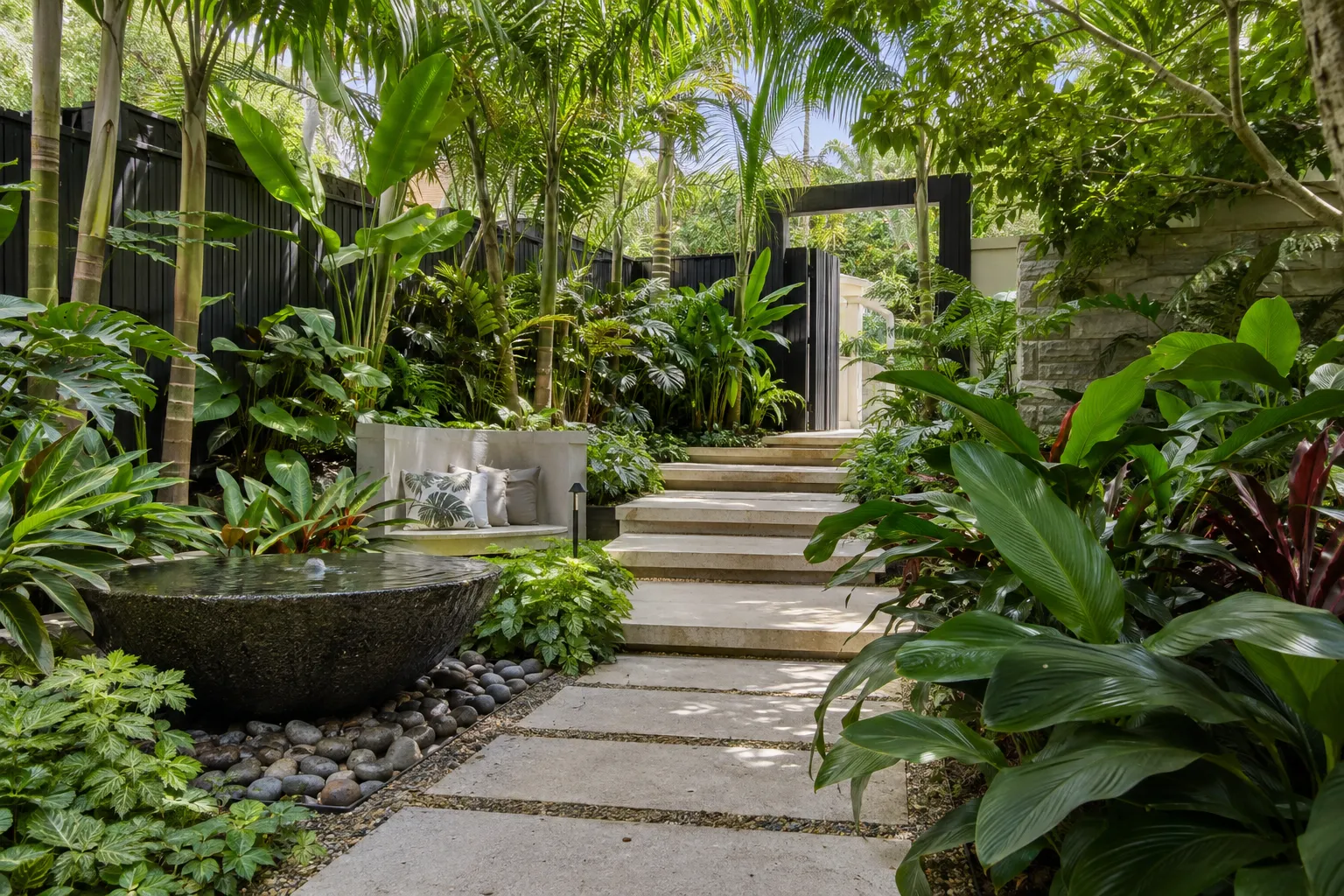
Flowering accents: colour without clutter
A restrained approach to colour generally produces a stronger result in Sydney than attempting to match the vivid multi-coloured planting of a genuine tropical garden further north. The better strategy is to anchor the composition in green foliage and introduce colour through one or two species used consistently. The same restrained palette principle applies in very different climates, as we explore in our piece on country garden design.
- Canna lilies in deep red or orange provide bold seasonal flower colour and a strong upright form that creates vertical interest between the mid-storey and the canopy.
- Heliconias (cold-hardy cultivars such as Heliconia psittacorum) bring the distinctive lobster-claw flower form that reads immediately as tropical, and the taller cultivars contribute to the mid-storey.
- Clivias carry soft orange or yellow flowers in late winter, precisely when the garden otherwise reads at its most restrained, a useful quality in a composition that is otherwise foliage-dominated.
Hard landscaping and materials in a tropical design
The structural quality of a tropical garden depends as much on the materials chosen for paths, terraces, retaining walls and pool surrounds as it does on the planting. Materials that read as warm, natural and textured reinforce the immersive quality of the garden; materials that are cool, reflective or highly polished create a contrast that works against it.
What works and why
Hardwood timber decking is one of the most effective materials in a tropical composition. The warm brown tones of hardwood complement the deep greens of tropical foliage, and a deck that is raised slightly above garden bed level creates the separation of levels that adds spatial interest to a smaller garden.
Natural stone in basalt, sandstone or granite provides the grounded quality that tropical planting needs. A simply detailed stone terrace or a stone-capped retaining wall reads well against dense foliage because the material does not compete.
Corten steel edging used as a garden bed border has become a well-tested detail in contemporary tropical designs. The rust-red oxide finish against dark green foliage creates a contrast that is as deliberate as any plant choice.
Water features in a tropical context
Moving water is among the most effective elements in a tropical garden. The sound alone shifts the quality of the space, and even a modest wall-mounted water feature introduces a cooling, humid character that reinforces the tropical feel.
A water feature does not need to be large or complex to be effective. A stone-faced wall spout into a shallow basin, positioned where it can be heard from the main entertaining area, adds more to the atmosphere of the garden than a large planting bed of comparable cost. Still water in a dark-lined pond also reflects light back into the canopy, creating depth in smaller gardens.
Hardscape materials at a glance
| Material | Best use | Why it works in tropical gardens |
|---|---|---|
| Hardwood decking | Entertaining areas, raised terraces | Warm tone complements green foliage; practical for damp conditions |
| Basalt or dark granite paving | Paths, pool surrounds, terrace floors | Non-reflective, durable, pairs well with dark mulch and foliage |
| Natural sandstone | Retaining walls, steps, coping | Textured surface reads as grounded; weathers attractively |
| Corten steel | Garden bed edging, planters, screens | Rust tone contrasts with foliage; durable without maintenance coating |
| Rendered concrete | Feature walls, seat walls | Takes dark or warm render tones that recede behind planting |
Design decisions that reduce long-term maintenance
A densely planted tropical garden that has been well composed is often less demanding to maintain than a garden with open soil and scattered planting. Dense canopy shades out weeds; groundcovers retain moisture; and the competition for light among closely planted species regulates growth in a way that open planting cannot.
That said, maintenance load is a design decision that must be addressed at the documentation stage, not discovered after installation.
Three design choices that determine maintenance load
Species selection relative to mature size. A palm that reaches 12 metres in an 8-metre space will require costly removal and replanting. A landscape architect documents the expected mature dimensions of every species in the planting plan, and designs the composition around those dimensions, not the dimensions of the plant as installed.
Root management near structures. Palms with vigorous surface root systems, and species that spread by rhizome such as some cannas and heliconia cultivars, require considered placement relative to paving, retaining walls and pool structures. Installing root barriers during the construction phase is far less costly than removing damaged infrastructure later.
Mulch depth and type. A 75 to 100 mm layer of coarse organic mulch across all garden beds retains soil moisture, moderates soil temperature and reduces weed growth without the need for chemical suppression. Mulch is replenished as part of the annual maintenance schedule that Nicholas Bray Landscapes provides as a document alongside the planting plan. For how a planting plan is structured from the outset, see our piece on cottage garden design plans.
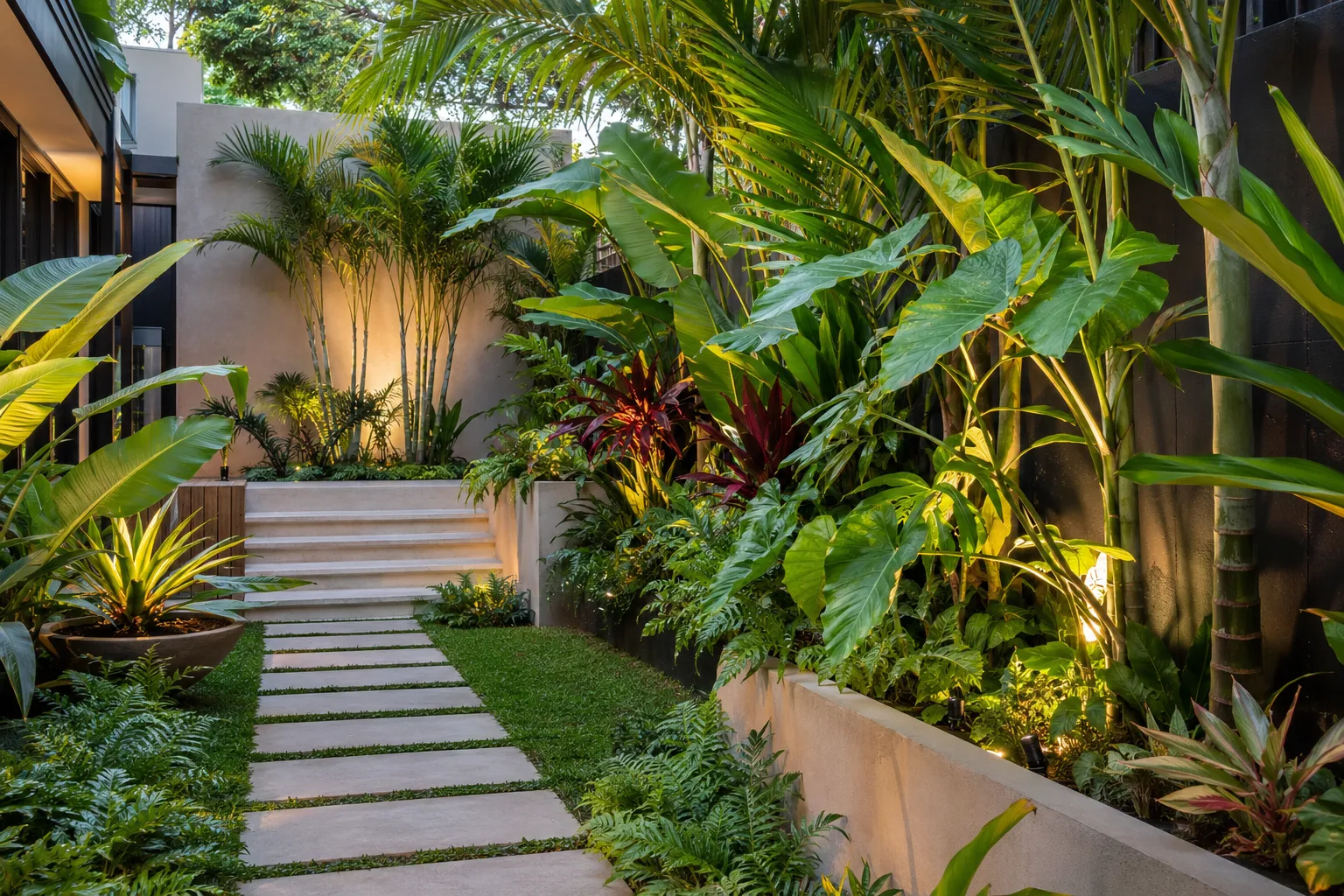
Creating a tropical garden in Sydney: what a landscape architect considers
Tropical garden design for a Sydney property is not a plant selection exercise. It is a site analysis exercise that results in a design composition, which is then documented for construction.
The process the practice follows considers:
- Site analysis: aspect, existing canopy, soil profile, drainage, wind exposure and proximity to boundaries or structures that affect light and root zones.
- Design intent: what spatial experience is the garden designed to deliver? Enclosure for an entertaining terrace, privacy from a neighbouring building, a visual connection from inside the house to a pool area?
- Plant composition: layer structure, species selection calibrated to the site’s microclimate, and a planting density that will achieve enclosure within a realistic timeframe.
- Hard landscaping: materials, drainage strategy, edging detail and any water features, designed as an integrated composition rather than selected separately from the planting.
- Construction documentation: detailed drawings, specifications and schedules from which a builder or specialist contractor can work accurately. Documentation reduces the risk of on-site substitutions that undermine the design intent.
- Maintenance schedule: a document specifying what needs to happen seasonally to keep the composition performing as designed.
Tropical garden design for a Sydney property is site-specific work. The right approach depends on aspect, soil, existing canopy, the proximity of structures and the spatial experience the design is intended to deliver.
Nicholas Bray Landscapes brings more than 30 years of landscape architecture, horticulture and environmental planning to each project. If you are considering a tropical garden for a Sydney property, book a consultation to discuss what is appropriate for your site.
Frequently Asked Questions
Can you create a tropical garden in Sydney?
Yes. Sydney’s warm summers and mild winters, particularly near the coast, support a wide range of tropical and subtropical species. The design approach is to select cold-hardy plants with a tropical aesthetic, protect sensitive species within the warmest positions on the site, and build the layered structure that gives a tropical garden its characteristic density and enclosure.
What are the best tropical plants for a Sydney garden?
The most reliable choices for Sydney include Bangalow palm (Archontophoenix cunninghamiana), kentia palm (Howea forsteriana), Australian tree fern (Cyathea cooperi), bird of paradise (Strelitzia nicolai), cordylines, shell ginger (Alpinia zerumbet), Philodendron ‘Xanadu’, bromeliads, clivias and bird’s nest ferns. Each should be placed according to its light, drainage and wind exposure requirements.
What is the biggest mistake in tropical garden design?
Flat planting, placing species at the same height without vertical structure or layering. A few tropical plants dotted through open mulch will never read as a tropical garden, regardless of species. The immersive quality comes from composing canopy, mid-storey, feature shrubs and groundcovers as an integrated system.
How much maintenance does a tropical garden need?
A well-designed tropical garden with the correct species, appropriate mulching and a clear planting structure generally requires less maintenance than it appears to. Dense planting suppresses weeds and retains moisture. The primary annual tasks are mulch replenishment, removal of dead fronds and periodic pruning of species that have reached or exceeded their intended scale.
Do tropical gardens work around swimming pools in Sydney?
Yes, with careful plant selection. Species for pool surrounds need manageable root systems that will not damage pool infrastructure, limited leaf drop that would clog filters, and tolerance of reflected heat and chemical splash. Bird of paradise, cordylines, selected palms and compact groundcovers are well-tested in pool settings. A landscape architect documents clear exclusion zones around the pool structure and specifies root barriers where needed.
Do I need council approval for a tropical garden in Sydney?
Residential gardens generally do not require a Development Application unless the work involves significant earthworks, retaining walls over a specified height, drainage that discharges to a street or waterway, or work within a heritage conservation area. A landscape architect can advise on what triggers approval on a specific property, and can prepare and manage any required documentation.
What materials suit a tropical garden in Sydney?
Natural, warm-toned materials work best. Hardwood decking, basalt or dark granite paving, sandstone and corten steel all complement tropical foliage without competing with it. Highly reflective or cool-toned materials such as white concrete or light porcelain paving can undermine the enclosed, grounded quality that tropical gardens depend on.
Planning your garden?
Talk to Nicholas Bray about your property.
Tell us a little about your site and what you have in mind, and we’ll be in touch to arrange a consultation.
Prefer to talk? Call 0417 278 267

About the author
Nicholas Bray, Registered Landscape Architect (RILA 958, AILA)
Nicholas Bray is the principal of Nicholas Bray Landscapes, a landscape architecture and construction business based in Moss Vale in the Southern Highlands. With 25 years of experience across landscape architecture, horticulture and environmental planning, he designs and builds gardens for large acreage estates, rural properties, vineyards, schools and commercial sites throughout the Southern Highlands, Central and Southern New South Wales.
Nicholas studied landscape architecture in Australia and Canada, and horticulture at the Royal Horticultural Society’s garden at Wisley in the United Kingdom. He has worked at the Hanbury Botanical Gardens in La Mortola, Italy, and completed projects in Spain, the United Kingdom, Singapore and Canada.
His work balances the built and natural environments with site specific planting, stonework, pools and water features, and he is well known for guiding complex landscape plans through council approval.