


A cottage garden is built on plants, not hard landscaping. The right mix of shrubs, perennials, climbers and self-seeding annuals gives it that layered, informal abundance, whether you’re planting a traditional English-style border or an Australian native cottage garden suited to a drier or frost-prone site. This guide sets out the species we use most often, how they’re composed into a working planting plan, and what a cottage garden genuinely needs to keep looking good through the seasons, so you can make an informed choice for your own garden before a single plant goes in the ground.
What Makes a Plant “Cottage Garden Style”?
A cottage garden plant is usually hardy, free-flowering and a little informal in habit, the opposite of a clipped, single-species hedge in a formal garden. Most cottage garden plants share a few traits that let them work together in a dense, layered bed. For a very different discipline within the same outdoor design world, see our guide to what is landscape construction.
- Long or repeated flowering. Many bloom for months, or flower more than once with deadheading.
- Soft, informal habit. Arching stems, loose flower spikes and self-seeding rather than tight, uniform shapes.
- A range of heights. Tall spires at the back, mounding fillers in the middle, low growers spilling over the edge.
- Fragrance. Scent is part of the style, from lavender and roses to native correas and boronias.
- Pollinator value. Open, nectar-rich flowers that draw bees, hoverflies and, with native species, honeyeaters.
Classic Cottage Garden Plants We Use
A traditional cottage garden is built in layers: structural shrubs for framework, perennials for colour and bloom, climbers for height, and low growers to soften the edges. The table below groups the species that do this reliably in Australian conditions.
| Role in the garden | Plants | Flower colour | Notes |
| Framework shrubs | Lavender (Lavandula), rose (Rosa), box hedging (Buxus) | Purple, pink or white, mixed | Give the bed structure that holds its shape once the perennials die back. |
| Perennial fillers | Foxglove (Digitalis purpurea), delphinium, hollyhock (Alcea rosea), catmint (Nepeta), salvia, cranesbill geranium | Purple, pink, white, blue | Foxglove and hollyhock supply the tall spires cottage gardens are known for. |
| Climbers | Climbing rose, wisteria, sweet pea (Lathyrus odoratus), honeysuckle | Pink, white, mauve | Used on arches, fences and walls to add height without taking bed space. |
| Edging and ground cover | Cottage pinks (Dianthus), lamb’s ear, low-growing thyme | Pink, white | Plants to spill out onto paths and soften hard edges. |
Many of these are also edible or useful: parsley, sage and thyme have sat at the front of cottage borders for centuries, alongside the flowers, and still earn their place today. See also our broader piece on front garden landscaping ideas for how these planted areas sit within the full entry sequence.
Australian Native Cottage Garden Plants
An Australian native cottage garden swaps English perennials for native species with a similar habit: mounding, free-flowering and informal, but adapted to Australian rainfall and soils. It keeps the cottage garden layout while cutting water use. For a fuller treatment of native species selection across the whole front yard, see our guide to low maintenance native garden front yard designs.
Native shrubs and framework
- Correa (native fuchsia), small tubular flowers, tolerates part shade, useful where English shrubs would struggle.
- Westringia (native rosemary), a hardy, evergreen alternative to clipped hedging.
- Grevillea cultivars, chosen for size, are a strong nectar source and flower for much of the year.
Native perennials and daisies
- Brachyscome (native daisy), a low, mounding filler with purple or white daisy-like flowers that self-seeds freely.
- Paper daisy (Xerochrysum bracteatum), papery, long-lasting blooms in a wide range of colours, good as a cut flower.
- Kangaroo paw (Anigozanthos), upright and colourful, popular with honeyeaters as well as native bees.
Native climbers and ground covers
- Hardenbergia (native sarsaparilla), a native climber with purple pea flowers, the closest equivalent to wisteria.
- Native violet (Viola hederacea), a shade-tolerant ground cover for softening path edges.
- Dianella (flax lily), strappy foliage with small blue flowers, useful where nothing else will hold the edge.
English Cottage Garden vs Australian Native Cottage Garden
Both styles share the same layout logic, framework, fillers, climbers and edging, but they differ in water use, flowering pattern and the wildlife they support. This comparison helps decide which suits a given site.
| Feature | Traditional English Cottage Garden | Australian Native Cottage Garden |
| Signature plants | Foxglove, delphinium, roses, lavender | Kangaroo paw, correa, grevillea, brachyscome |
| Water once established | Moderate to regular | Generally low, many are drought-adapted |
| Flowering pattern | Strong spring and summer flush | Flowers spread more evenly across the year |
| Wildlife drawn in | Bees and hoverflies | Native bees, hoverflies, honeyeaters and butterflies |
| Best suited to | Cool-climate gardens with a genuine winter | A wider range of Australian climates, including drier sites |
Most gardens we design don’t sit purely in one camp. A native cottage garden layout with a climbing rose on the entry arch, or an English-style bed with grevillea worked through it, is often the more resilient result. For how cottage planting principles apply in a warmer, subtropical climate, see our piece on tropical garden designs.
How We Compose a Cottage Garden Planting Plan
A convincing cottage garden looks unplanned, but it isn’t. The layered, abundant effect comes from a deliberate planting plan, not a random scatter of favourites picked up at the nursery.
Layering and structure
Every bed needs a backbone of evergreen shrubs before the perennials go in. Without it, a cottage garden collapses into bare soil every winter and takes months to build the feeling of abundance back up each spring.
Colour and bloom succession
We choose a restrained colour palette, usually two or three related colours plus white, and stagger flowering so something is always in bloom. A bed that flowers all at once in spring and does nothing for the rest of the year isn’t doing its job.
Matching plants to site conditions
Full sun, part shade, soil drainage and exposure decide the plant list before style does. A foxglove or a grevillea planted in the wrong aspect will underperform regardless of how well it suits the look you want. For how these decisions come together into a full plan, see our piece on cottage garden plans.
Cottage Gardens in a Cool-Climate Setting
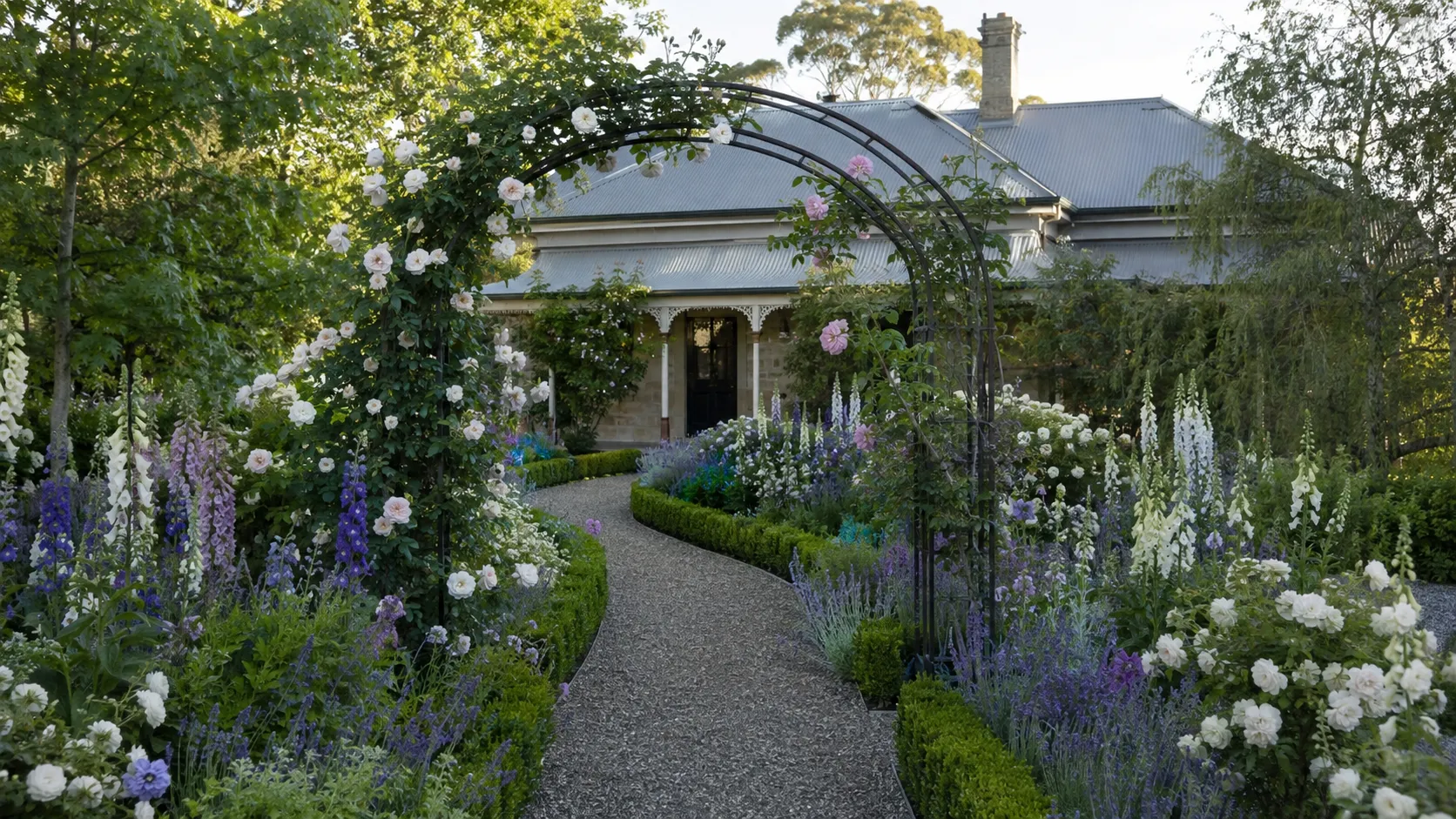
The Southern Highlands’ cooler, four-season climate genuinely suits the traditional cottage garden style, which is one reason it reads so well in this district compared with warmer parts of NSW. For a full guide to garden design in this specific region, see our piece on country garden designs.
- Winter chill lets roses, foxgloves and other deciduous or dormant perennials perform properly, something that’s harder to achieve in warmer coastal gardens.
- Frost-prone spots favour hardier natives such as westringia and correa over more tender exotics.
- Exposed sites benefit from a windbreak layer before the softer cottage planting goes in behind it.
Keeping a Cottage Garden Looking Its Best
A cottage garden isn’t a low-maintenance style, and it’s worth being honest about that upfront. It rewards attention rather than heavy labour, and most of that attention is about editing rather than hard work.
- Deadheading extends the flowering window on most perennials and keeps self-seeders from taking over.
- Framework shrubs generally need one structural prune a year to hold their shape.
- Self-seeding plants like foxglove and brachyscome need editing each season, or they’ll spread further than intended.
Every planting plan we prepare comes with a maintenance schedule, so whoever looks after the garden, a family member, a gardener or a maintenance contractor, knows exactly what each plant needs and when. Where properties have environmental overlays or bushland proximity, environmental planning considerations also shape the planting brief.
Common Cottage Garden Mistakes
Most cottage garden problems come from missing structure or ignoring the site, not from choosing the wrong flowers. These are the mistakes we see most often. The same structural thinking applies in more formal rural settings, as we explore in our piece on French provincial home design.
- No framework planting. A bed of perennials with no evergreen shrubs looks bare for half the year.
- Ignoring aspect. Planting a full-sun favourite like lavender or foxglove into shade, or the reverse.
- Letting self-seeders run. Some cottage garden favourites spread beyond the bed and into neighbouring garden beds or bushland if left unchecked.
- Treating “informal” as “unplanned”. The relaxed look still needs a plant list and a layout, or it reads as neglect rather than style.
When to Bring in a Landscape Architect
A small cottage border is a reasonable project to plant yourself. A full garden layout, especially one working around existing trees, drainage, slope or a heritage-style house, is better handled through a proper garden landscaping process, with a documented plan before anything goes in the ground.
Nicholas Bray Landscapes has more than 30 years in landscape architecture and horticulture, including training at the Royal Horticultural Society’s garden at Wisley in Surrey. That background is what turns a plant list into a garden that still works in five years, not just on planting day.
Frequently Asked Questions
What is a cottage garden?
A cottage garden is an informal planting style built from a dense mix of flowering shrubs, perennials, climbers and self-seeding annuals, arranged in layers rather than rows. It favours abundance and softness over the symmetry of a formal garden, while still relying on a planned structure underneath.
What’s the difference between an English cottage garden and an Australian native cottage garden?
Both use the same layered layout of shrubs, fillers, climbers and edging. An English cottage garden leans on exotic perennials like foxglove and delphinium, while a native cottage garden uses drought-adapted Australian species such as kangaroo paw and correa in the same roles.
What are the best cottage garden plants for Australian conditions?
Lavender, roses, salvia and catmint perform reliably in most Australian gardens, while brachyscome, correa, grevillea and kangaroo paw suit drier or native-focused sites. The right list depends on your climate, soil and how much water the garden will realistically get.
Can native plants really work in a cottage garden?
Yes. Native cottage garden plants share the same habits that define the style, mounding growth, long flowering and self-seeding, so they slot into the same layered layout as traditional cottage garden species. Brachyscome, correa and kangaroo paw all do this while using considerably less water once established.
Do cottage garden plants need full sun?
Many classic cottage garden favourites, including lavender, roses and foxglove, prefer full sun to part shade. Shadier spots do better with correa, native violet or hellebores, so aspect should guide plant choice before style does.
Are cottage gardens low maintenance?
Not particularly. Cottage gardens need regular deadheading, some editing of self-seeders and an annual structural prune of framework shrubs to hold their shape. They’re manageable rather than low effort, and a documented maintenance schedule makes that ongoing upkeep predictable for whoever ends up doing it.
What plants soften the edges of a cottage garden path?
Low growers that spill out over hard edges work best: cottage pinks, native violet, brachyscome and low-growing thyme are all common choices. They blur the line between path and bed, which is a large part of what gives an informal cottage garden its relaxed, lived-in character.
Should I hire a landscape architect for a cottage garden?
A small border is a reasonable DIY project. A full garden layout, particularly one that needs to work with existing trees, slope, drainage or a heritage-style house, benefits from a documented planting plan prepared by a landscape architect before planting begins.
Planning your garden?
Talk to Nicholas Bray about your property.
Tell us a little about your site and what you have in mind, and we’ll be in touch to arrange a consultation.
Prefer to talk? Call 0417 278 267

About the author
Nicholas Bray, Registered Landscape Architect (RILA 958, AILA)
Nicholas Bray is the principal of Nicholas Bray Landscapes, a landscape architecture and construction business based in Moss Vale in the Southern Highlands. With 25 years of experience across landscape architecture, horticulture and environmental planning, he designs and builds gardens for large acreage estates, rural properties, vineyards, schools and commercial sites throughout the Southern Highlands, Central and Southern New South Wales.
Nicholas studied landscape architecture in Australia and Canada, and horticulture at the Royal Horticultural Society’s garden at Wisley in the United Kingdom. He has worked at the Hanbury Botanical Gardens in La Mortola, Italy, and completed projects in Spain, the United Kingdom, Singapore and Canada.
His work balances the built and natural environments with site specific planting, stonework, pools and water features, and he is well known for guiding complex landscape plans through council approval.