


A low maintenance front yard with Australian native plants is achievable on most residential properties, but it rarely happens by chance. The decisions that determine how much ongoing care a garden demands come early: which species are selected, how soil is prepared, where drainage is directed, and how planting is structured relative to hard surfaces. This article explains how those decisions are made from a landscape architecture perspective, and what distinguishes a genuinely low-care native garden from one that simply looks the part in its first season.
Why native plants are not automatically low maintenance
Australian native plants are adapted to the country’s climate, but “native” alone does not equal low effort. The plants still need to match the specific conditions of the site: aspect, drainage, soil type, and local rainfall patterns. A species that thrives in coastal Sydney can struggle in the Southern Highlands or the Blue Mountains, and grouping plants with different water needs creates ongoing problems regardless of how well adapted each individual species is.
Three factors determine the long-term maintenance load in a native front garden:
- Species-to-site fit: natives selected for the actual conditions of the block rarely need intervention once established. Those planted outside their natural range often require persistent remedial work.
- Plant grouping: species with similar water and soil requirements planted together simplify care considerably. Mixing drought-tolerant species with moisture-loving ones creates a perpetual management problem.
- Garden structure: the ratio of planting to hard surface, path placement, bed edging, and mulch depth all affect how easy the garden is to manage week to week.
These questions are most honestly addressed at the design stage, before a single plant goes into the ground. On a larger rural site, designing a country garden extends that planning beyond the front boundary to the wider landscape.
Reading the site before choosing a plant
Site analysis precedes plant selection in any well-considered landscape design. For a front garden, the key variables are aspect, soil drainage, the distance from the street boundary to the house, existing trees or structures that cast shade, and any Council requirements around sightlines near driveways and footpaths.
Aspect
Aspect is decisive in an Australian front garden. A north-facing front receives full sun for much of the day and suits a broad range of native species. A south-facing front is substantially shadier and calls for a different palette: shade-tolerant groundcovers such as native violet (Viola hederacea), lomandra varieties that handle lower light, and ferns suited to cool, moist positions.
Soil drainage
Drainage is easy to misjudge on a residential block. Many suburban soils compact significantly during construction, and clay-heavy ground that holds water after rain will limit plant choice and can cause root disease even in drought-tolerant species. A landscape architect will assess drainage before the design is confirmed, and may recommend soil remediation before planting. Heavy mulching alone does not resolve a structural drainage problem.
Council requirements
Some councils specify minimum sight-distance triangles at driveways and footpath boundaries that restrict plant height within a setback zone. Some heritage overlay areas have guidelines around plant species, hard surface materials, or garden character. Checking council controls before finalising a design prevents costly changes after installation.
Building the plant palette: a selection guide
The most resilient low maintenance native front gardens use a composed palette rather than a collection of individual specimens. That means selecting plants across three functional layers: structural or canopy plants, mid-layer shrubs, and groundcovers: and choosing within each layer for site fit and visual coherence. The table below covers species commonly used across NSW front gardens.
| Plant | Botanical name | Layer | Suited to | Notes |
| Grass tree | Xanthorrhoea spp. | Structure | Full sun, well-drained | Sculptural, long-lived, slow to establish but very low upkeep |
| Kangaroo paw | Anigozanthos spp. | Mid-layer | Full sun, sandy or loamy | Remove spent flower stems; select cultivar suited to local climate |
| Lomandra | Lomandra longifolia | Mid-layer | Sun to part shade, adaptable | Suppresses weeds between plantings; very low water once established |
| Compact grevillea | Grevillea spp. (named cultivar) | Mid-layer | Full sun, well-drained | Year-round flower and wildlife value; size varies significantly by cultivar |
| Native violet | Viola hederacea | Groundcover | Part to full shade | Dense spreading groundcover for shaded beds; frost tolerant |
| Creeping boobialla | Myoporum parvifolium | Groundcover | Full sun, dry | Rapid cover between shrubs; reduces bare soil and weed establishment |
| Dianella | Dianella caerulea | Mid-layer | Sun to part shade, adaptable | Strappy foliage, blue berries, very low water requirements when established |
| Coast banksia | Banksia integrifolia | Canopy / structure | Full sun, coastal | Long-lived habitat plant; tolerates salt spray and sandy soils |
Botanical names matter in this context. Many cultivated native varieties have been selected specifically for compact growth, improved drought performance, or reduced seed production. A landscape architect will specify named cultivars where they exist rather than leaving species selection to chance at the nursery.
Hardscape elements that reduce ongoing workload
The non-planted elements of a front garden, paths, edging, gravel surfaces, and bed borders, do as much to determine maintenance effort as the plant palette does. A well-considered design uses hardscape to define clear edges, reduce the area requiring weeding, and give planting a structure it can grow into over time. The same relationship between paths and planting is explored in more front garden landscaping ideas for Australian homes.
Paths and surfacing
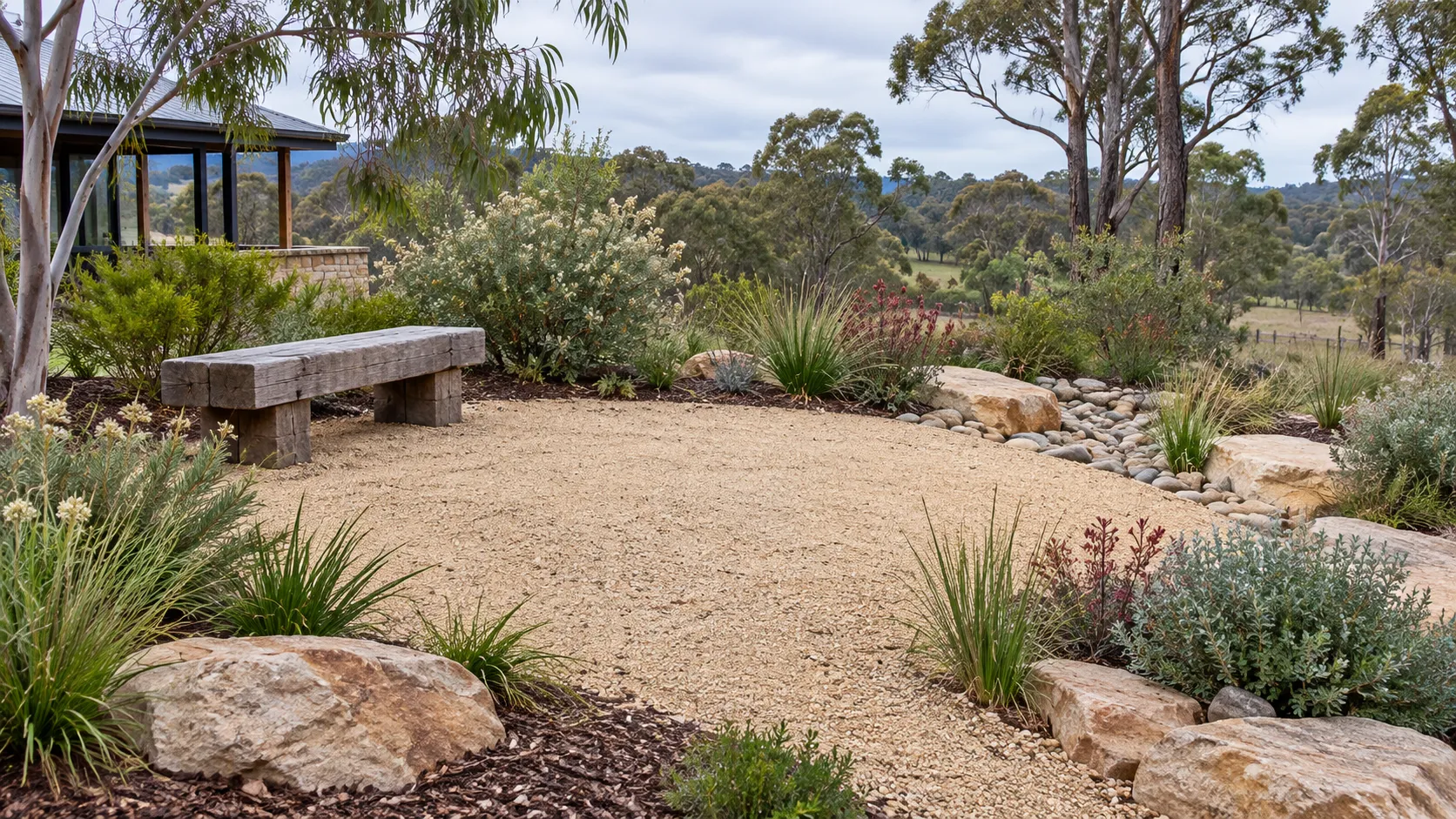
Decomposed granite and gravel paths are practical in native gardens and complement the naturalistic character of Australian planting. Both are permeable, which supports drainage and reduces stormwater runoff to the street. A path of at least 1.2 metres for a main approach removes foot traffic from planted beds and reduces soil compaction around root zones.
Garden bed edging
Clear bed edges reduce maintenance significantly over time. Corten steel edging creates a clean, durable line between planting areas and gravel or lawn without requiring repeated trimming. Natural sandstone or local stone edging suits properties where a more settled character is appropriate. Either approach eliminates the labour of re-cutting soft edges after rain.
Mulch depth and type
75 to 100 millimetres of coarse hardwood or eucalypt chip mulch reduces weed germination and slows moisture loss between rainfall events. Fine mulch decomposes quickly and needs replacing more often. Mulch should be kept clear of plant crowns, particularly around grass trees and lomandra, where excess moisture at the crown base can cause rot.
Drainage and water management in the front garden
Front gardens sit between the house and the street, which makes stormwater management a real design factor. Water from roof runoff, the driveway, and surrounding hard surfaces often concentrates in front garden beds. Plants sitting in poorly drained soil can decline within a season even if they are drought-tolerant species under normal conditions.
Overland flow paths should be identified before the design is finalised. On sloped sites, shaped garden beds or shallow swales can direct water to an appropriate outlet rather than allowing it to pool at the base of plants. On flatter suburban blocks, mounded planting areas or raised beds lift root zones clear of seasonally wet ground.
Soil preparation is as important as drainage design. Breaking up compacted subsoil with gypsum, incorporating organic matter into the top 300 millimetres before planting, and adding gravel into heavy clay around drainage corridors all improve conditions at the root zone where surface remediation alone cannot reach.
Front garden design approaches for Australian homes
Australian native plants suit a range of design characters, and the approach should respond to the architecture of the house rather than be chosen independently of it. A contemporary rendered house reads differently from a Federation-era brick cottage or a rural weatherboard property. The front garden should extend the character of the building, not contradict it. A cottage-style frontage has different planting demands; cottage garden plans show how its informal beds can be given a clear structure.
Contemporary naturalistic
Informal drifts of grasses, lomandra and dianella with punctuation from grass trees and compact grevilleas. Gravel or decomposed granite surfacing. Clean, simple edging. This approach suits modern house styles and requires minimal intervention once established. The visual interest comes from texture and foliage form rather than high-colour planting.
Structured native
Native plants used with formal massing: repeated drifts of a single species, or clipped hedges of westringia or leptospermum with specimen plantings at key focal points. More labour during establishment, but very low maintenance once the hedge mass fills in. Works well with symmetrical facades and properties where a composed, ordered character is intended. A similarly ordered layout can suit the entry to a French provincial home, provided the plant palette is chosen for the local conditions.
Coastal or dry garden
A palette of drought-tolerant species, including banksia, coastal rosemary (Westringia fruticosa), pigface (Carpobrotus glaucescens), and low-growing she-oaks. Suited to coastal and near-coastal properties, and to areas with sandy, free-draining soil where supplementary irrigation is impractical. Requires almost no water once established.
Cool-climate native
Properties in the Southern Highlands, Blue Mountains, and tablelands call for a different palette. Suitable species include snow daisy (Celmisia spp.), mountain grevillea cultivars, sedge groundcovers such as Carex appressa, and alpine ash for larger gardens. These zones experience genuine frosts and hot, dry summers, which eliminates species that perform reliably in coastal or urban environments. In humid, warmer climates, tropical garden design ideas call for a different palette and approach to shade and moisture.
What the landscape design process covers for a front garden
A residential front garden design from a registered landscape architect produces more than a planting list. The documentation allows the garden to be built and maintained as intended, rather than interpreted differently on site by each contractor.
- Site analysis: mapping existing drainage patterns, aspect, soil type, root zones from established trees, and any Council constraints
- Concept layout: positioning of paths, planting beds, hard surface areas, and any structures such as letterboxes, lighting or privacy screens
- Planting plan: species, quantities, spacing, and establishment requirements with botanical names, and notes on soil preparation
- Construction documentation: edging, surfacing, drainage, and any walls or structures drawn to a standard contractors can price and build from accurately
- Maintenance schedule: a written document specifying what is required in the first twelve to twenty-four months to establish the garden successfully
This documentation is what the practice means by residential landscape design. Understanding what is involved is the starting point for every consultation.
Choosing the right approach: a summary by site type
| Site type | Design approach | Key species | Maintenance consideration |
| North-facing, open sun | Contemporary naturalistic or structured native | Lomandra, grevillea, dianella, grass tree | Establish with mulch and irrigation; very low once settled |
| South-facing, shaded | Cool, layered planting | Native violet, shade lomandra, bird’s nest fern, lilly pilly | Slower to establish; monitor moisture in establishment phase |
| Coastal, sandy soil | Coastal or dry garden | Banksia, westringia, pigface, she-oak | Minimal water requirements after twelve months |
| Cool climate (Highlands, tablelands) | Cool-climate native | Snow daisy, mountain grevillea, Carex appressa | Frost exposure shapes species choice; avoid coastal natives |
| Sloped with drainage pressure | Any style, drainage-first design | Site-specific: drainage resolution precedes planting | Soil preparation and drainage correct before planting begins |
If you are planning a native front garden and want to understand what is genuinely achievable on your site, Nicholas Bray Landscapes offers site consultations across Australia.
Every project begins with a site consultation. Book a consultation with Nicholas Bray Landscapes to discuss what is appropriate for your property.
Frequently asked questions
What are the lowest-maintenance Australian native plants for a front garden?
Lomandra, dianella, creeping boobialla (Myoporum parvifolium), and compact grevillea cultivars are among the most reliable choices across NSW. Grass trees (Xanthorrhoea) are exceptionally long-lived and require almost no intervention once established. Species selection should always be confirmed against the specific conditions of the site: aspect, drainage, and climate zone.
How much mulch does a native front garden need?
75 to 100 millimetres of coarse hardwood or eucalypt chip is the practical minimum for effective weed suppression and moisture retention. Fine or shredded mulch breaks down faster and needs replacing more often. Keep mulch away from plant crowns, particularly grass trees and groundcovers, to prevent collar rot during wet periods.
Do Australian native front gardens require irrigation once established?
Most established native gardens across NSW require minimal supplementary irrigation when species are well matched to local rainfall and soil. The establishment period, typically twelve to twenty-four months, usually requires supplementary watering. After that, many species can rely on natural rainfall, though a prolonged dry summer may require occasional deep watering to carry plants through.
Can Australian natives work in a shaded or south-facing front garden?
Yes. A south-facing or heavily shaded front calls for a different palette: native violet (Viola hederacea), shade-tolerant lomandra varieties, bird’s nest fern (Asplenium australasicum), lilly pilly (Syzygium spp.), and shade-adapted groundcovers. The key is selecting for the actual light conditions rather than assuming all native plants prefer full sun.
What does a landscape architect do differently from a nursery recommendation?
A registered landscape architect assesses site conditions, drainage, aspect, and council requirements before recommending any species. The design is then documented in a planting plan and construction drawings that a contractor can build from accurately. A nursery recommendation is based on general information; a landscape design is based on the specific conditions of your property.
How does council affect what I can plant in my front garden?
Some councils specify minimum sight triangles at driveways and footpath crossings that restrict plant height within the boundary setback. Heritage overlay areas may have guidelines on species, materials, or garden character. A landscape architect reviews relevant controls before finalising the design, which prevents work that needs to be altered or removed after installation.
When is the best time of year to plant a native front garden in NSW?
Autumn, March to May, is generally the most effective planting window across NSW. Cooler temperatures and more reliable rainfall reduce establishment stress on new plants. Spring planting is possible but places new plants heading into a dry summer, which increases irrigation requirements. Summer planting is high risk without consistent and careful irrigation management.
What is the difference between a naturalistic and a structured native front garden?
A naturalistic front garden uses informal drifts of grasses, groundcovers and shrubs to create a garden that reads as settled rather than designed. A structured native garden uses the same plant palette with deliberate massing, repeated species, or clipped hedges to create a more composed, intentional character. Both can be low maintenance, but the structured approach requires more care during the establishment phase.
Planning your garden?
Talk to Nicholas Bray about your property.
Tell us a little about your site and what you have in mind, and we’ll be in touch to arrange a consultation.
Prefer to talk? Call 0417 278 267

About the author
Nicholas Bray, Registered Landscape Architect (RILA 958, AILA)
Nicholas Bray is the principal of Nicholas Bray Landscapes, a landscape architecture and construction business based in Moss Vale in the Southern Highlands. With 25 years of experience across landscape architecture, horticulture and environmental planning, he designs and builds gardens for large acreage estates, rural properties, vineyards, schools and commercial sites throughout the Southern Highlands, Central and Southern New South Wales.
Nicholas studied landscape architecture in Australia and Canada, and horticulture at the Royal Horticultural Society’s garden at Wisley in the United Kingdom. He has worked at the Hanbury Botanical Gardens in La Mortola, Italy, and completed projects in Spain, the United Kingdom, Singapore and Canada.
His work balances the built and natural environments with site specific planting, stonework, pools and water features, and he is well known for guiding complex landscape plans through council approval.