


The front garden is where a house meets the landscape, and that threshold deserves more than an afterthought. Good front garden design for Australian homes considers aspect, soil, drainage and the climate zone before plants, materials or structure.
Whether you are working with a compact suburban block in Sydney’s Northern Beaches or a generous country entry in the Southern Highlands, the decisions that shape a front garden that holds are the same. This article covers what those decisions are and how a landscape architect approaches them.
Why the front garden is a landscape architecture question, not just a garden decision
Most front garden renovations start with a plant list or a paving quote. The gardens that hold up over time start with a site analysis instead. A landscape architect reads the front of a property differently: where does water sheet off the driveway, where does the afternoon sun hit, is the soil compacted from construction?
Those answers determine what will actually succeed, and they are settled before a single plant or paving material is chosen.
A few questions worth settling before any design work begins:
- What is the aspect? A north-facing frontage in coastal NSW behaves very differently from a south-facing one in the Southern Highlands.
- How does water move across the block? Ponding, cracking clay or runoff toward the house foundation all shape the design before aesthetics do.
- What does the front of the house actually need? Arrival sequence, privacy, shade for windows, or something to frame the entry.
- How much time is genuinely available for ongoing care? Not the optimistic version, the realistic one.
For a planting approach that follows these principles, explore low-maintenance front yard native garden ideas.
Low-maintenance front garden design: what it actually means in Australian conditions
A low-maintenance front garden for Australian homes is not a gravel bed with three succulents. It is a garden composed so that its ongoing needs are predictable and modest, not absent.
The real maintenance savings come from matching plants to conditions, managing soil health from the outset and designing hardscape so it does not trap debris or require constant edging.
What reduces long-term maintenance load
Mulch depth matters. A 75 to 100 mm layer of hardwood or cypress mulch suppresses weed germination, retains soil moisture and moderates temperature. Anything thinner invites weeds through within a season.
Weed control under gravel. Skip a quality membrane and you will be removing grass from gravel within eight months. Peg it properly and cover it with at least 70 mm of material.
Plant density and species count. Three species repeated across a bed read better from the street and are easier to manage than ten used once each. Repetition creates structure; structure reduces the visual noise that triggers the impulse to tinker.
Australian native plants for front gardens: choosing for climate and place
Australian natives are not automatically low-maintenance, but correctly selected species for a given climate are close to it. The difference between a garden that thrives and one that struggles is usually not the genus, it is the cultivar and the match to local conditions.
| Plant | Climate suitability | Role in the front garden | Water once established |
|---|---|---|---|
| Lomandra longifolia ‘Tanika’ | All zones | Low border, mass planting | Very low |
| Westringia fruticosa | Coastal, temperate | Formal hedging, low mound | Low |
| Grevillea ‘Robyn Gordon’ | Temperate, subtropical | Feature shrub, wildlife | Low |
| Kangaroo paw (Anigozanthos spp.) | Drier climates, full sun | Colour accent, mid-height | Low to moderate |
| Dianella tasmanica | Cool-climate to temperate | Edging, understorey | Low |
| Callistemon viminalis ‘Little John’ | Temperate, subtropical | Compact screening, colour | Low |
In the cool-climate Southern Highlands, the plant palette shifts. Westringia holds well in frost. Native violets (Viola hederacea) work as low groundcovers under canopy.
Grevillea victoriae is a better choice than subtropical species that will not survive a genuine winter. Choosing for place rather than choosing generically is what separates a design that settles in from one that needs replacing.
For planting around an informal path, cottage garden plans offer a useful starting point.
Garden beds, edging and hardscape: how structure shapes the front garden
The bones of a front garden, its paths, edges, garden bed layout and paving, do more visual work than the planting. A well-resolved hardscape composition reads as considered even when plants are young and establishing.
Garden bed placement
Garden beds in a front garden should do two things: frame the entry and soften the transition from hard surface to the house. A bed that simply borders a fence without any relationship to the front door or the building’s lines is a missed opportunity.
Raised garden beds work well on compacted soils or where drainage is poor. They lift the planting plane, improve soil conditions and give the front garden a clear structure that reads from the street.
In the Southern Highlands, raising beds also keeps plant crowns out of pooling water during winter, which reduces crown rot on natives and succulents alike.
Paving and path design
The path from the street to the front door is the spine of the front garden. A narrow concrete strip dropped through the middle of a lawn is rarely the best option. Wider paving, generous enough to walk two abreast, gives the entry sequence the weight it deserves.
Material choices that hold up well in Australian conditions:
- Concrete pavers, large format. Clean and contemporary, appropriate for modern Australian homes. Scale them up; small pavers read as fussy.
- Exposed aggregate concrete. Warm, textural, practical on slopes where grip matters.
- Decomposed granite or gravel paths. Informal register, suits cottage and native gardens. Needs a firm edge to hold it.
- Sandstone or bluestone. A more refined quality. Suits period architecture and country properties. Irregular flagging works better than square-cut on informal gardens.
On a more formal frontage, the material palette can also draw on French provincial home ideas.
Drought-tolerant planting and water-wise design decisions
Drought-tolerant planting is a condition of designing honestly for the Australian climate. In practice, it means understanding the water requirement of every plant at establishment, not just once it is mature.
The goal is a garden where irrigation at the establishment does not have to become a permanent fixture. That outcome is determined by plant selection, soil preparation and mulch depth, all of which are design decisions.
How a landscape architect approaches water use
The irrigation question is decided at the design stage, not the installation stage. Whether a garden needs drip irrigation, a temporary establishment watering plan or can rely on seasonal rainfall is determined by plant selection, soil preparation and mulch depth.
In Sydney’s Northern Beaches and coastal NSW, established natives and succulents often need no supplemental irrigation after the first two summers. In the Southern Highlands, summer is drier than many assume, but plants suited to cool temperate conditions establish quickly if soil preparation is correct.
A well-composed drought-tolerant front garden is guided by these principles:
- Group plants with similar water requirements together in a single zone.
- Place moisture-retentive mulch over all garden beds before planting, not after.
- Choose groundcovers that compete with weeds, not with each other. Dichondra repens works in shadier spots; compact Lomandra cultivars in full sun positions.
Focal points and structure: specimen trees, corten steel and vertical elements
A front garden without a focal point is a space the eye passes over rather than rests in. A focal point can be a specimen tree, a corten steel planter, a structured water feature, a topiarised form or a single well-placed boulder.
What matters is that something earns that role, and that everything else in the composition is arranged to support it.
Specimen trees for the front garden
A mature tree at the front of a property does something no other element can: it gives the house a sense of permanence and settlement. Species selection should consider canopy spread at maturity versus available space, root behaviour near paths and structures, and seasonal interest.
Crepe myrtles (Lagerstroemia) give summer colour and winter structure. Ornamental pears (Pyrus calleryana) provide autumn colour and canopy in temperate climates. In cool climates such as the Southern Highlands, Betula species are elegant and manageable in a front garden context.
Corten steel in the front garden
Corten steel suits contemporary architecture and weathers to a warm, settled rust that reads as deliberate. Used as garden bed edging, raised bed walls or a free-standing feature panel, it gives the front garden a material anchor with real longevity.
The practical consideration: corten does stain paving and concrete during the initial rusting phase. Either allow for staining on the adjacent surface or apply a sealer on the paving if discolouration is a concern.
Front garden design for small blocks: making a compact space work
A small front garden in a suburban context is a different design problem from a generous country house entry. The temptation is to include too much. The discipline is to decide on one strong idea and execute it well.
Approaches that work on compact front yards
The planted verge extension. Where the council permits it, extending planting into the nature strip softens the transition from street to property. Native groundcovers and grasses suited to pedestrian traffic, such as Dichondra or compact Lomandra, are appropriate choices.
Vertical planting. A boundary wall or fence is a planting plane, not a hard edge. Espaliered plants, climbers on a trellis or a green wall panel on a rendered surface all add vegetation without consuming ground area.
A drip irrigation system on a simple timer is the difference between a green wall that thrives and one that fails within a season.
Simplify the palette. Two or three materials and three well-chosen species will always read better from the street than a collection of competing ideas. For a small front garden, restraint is the governing design principle.
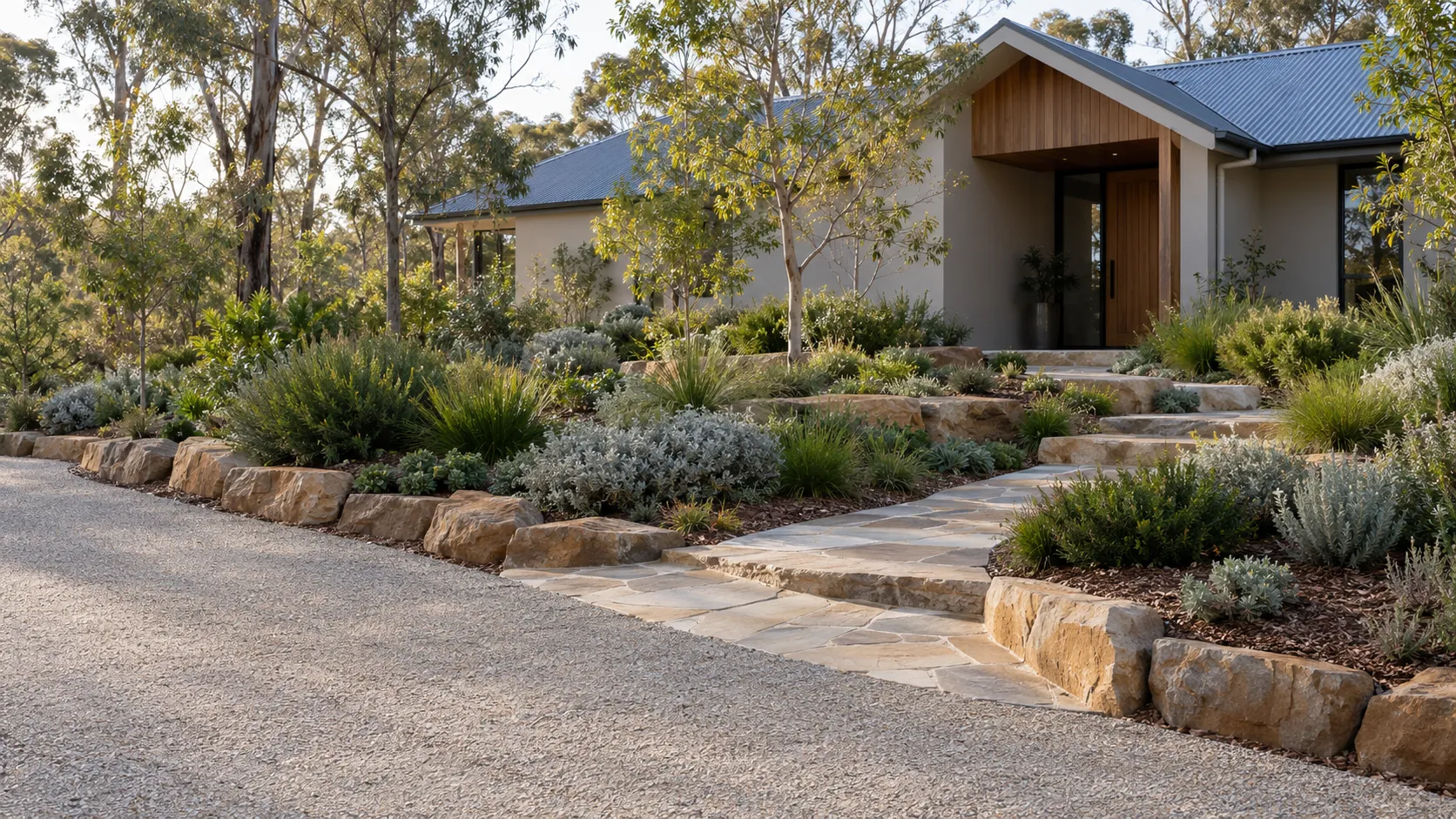
How front garden design fits into a broader residential landscape plan
The front garden does not exist in isolation. On properties where the entry sequence, car parking, side access and rear garden all need to be considered together, a master plan ensures that design decisions are coordinated rather than made piecemeal. The same thinking applies when designing a country garden across a larger property.
For properties in the Southern Highlands, Sydney and regional NSW, Nicholas Bray Landscapes approaches residential landscape design from the front entry through to the rear garden as a single composition. The front garden design is the first chapter of that plan. A residential landscape design consultation is the starting point for that conversation.
If you are planning a front garden for a residential property in Sydney, the Northern Beaches, the Southern Highlands or regional NSW, book a consultation with Nicholas Bray Landscapes to discuss your site.
Nicholas Bray Landscapes deliver beautiful gardens that people want to live in.
Frequently Asked Questions
What is the most important consideration in front garden design for Australian homes?
Site conditions come first. Aspect, drainage, soil type and climate zone determine what will succeed. A design that starts with aesthetics and ignores site conditions usually requires significant revision within a few seasons. A landscape architect reads the site before selecting plants or materials.
What are the best low-maintenance plants for Australian front gardens?
Westringia fruticosa, Lomandra longifolia cultivars and Grevillea species are consistently reliable across a wide range of Australian climates. In cooler zones such as the Southern Highlands, Dianella tasmanica and compact Grevillea victoriae cultivars perform well. Correct species selection for the specific location matters more than the genus alone.
How deep should mulch be in a front garden bed?
75 to 100 millimetres is the useful range. Hardwood or cypress mulch at this depth suppresses weed germination, retains soil moisture and moderates temperature. Keep mulch pulled back from plant stems to avoid collar rot.
What paving materials work best in Australian front garden design?
Large-format concrete pavers, sandstone, bluestone and exposed aggregate concrete all suit Australian conditions. The choice should reflect the architectural style of the house and the intended character of the garden. Gravel and decomposed granite suit informal gardens but need a firm edge to stay contained.
When should a landscape architect be involved in a front garden project?
The earlier the better. A landscape architect can inform decisions about drainage, garden bed layout, plant selection and material specification before any construction begins. On sites with drainage problems, significant slopes or council requirements, professional involvement at the design stage avoids costly corrections later.
Is corten steel appropriate for Australian front gardens?
Yes, in the right context. Corten steel suits contemporary and modern Australian architecture and weathers to a warm, settled rust over time. It works well for garden bed edging, raised bed walls and feature panels. Note that it stains adjacent paving during the initial rusting phase; a sealer on the paving surface manages this.
Do Australian native plants need irrigation once established?
Most correctly selected native plants are self-sufficient after two growing seasons with good soil preparation and mulching. During establishment, consistent watering is important. The key is choosing species suited to the rainfall patterns of the specific location rather than relying on a general assumption that all natives are drought-proof.
Planning your garden?
Talk to Nicholas Bray about your property.
Tell us a little about your site and what you have in mind, and we’ll be in touch to arrange a consultation.
Prefer to talk? Call 0417 278 267

About the author
Nicholas Bray, Registered Landscape Architect (RILA 958, AILA)
Nicholas Bray is the principal of Nicholas Bray Landscapes, a landscape architecture and construction business based in Moss Vale in the Southern Highlands. With 25 years of experience across landscape architecture, horticulture and environmental planning, he designs and builds gardens for large acreage estates, rural properties, vineyards, schools and commercial sites throughout the Southern Highlands, Central and Southern New South Wales.
Nicholas studied landscape architecture in Australia and Canada, and horticulture at the Royal Horticultural Society’s garden at Wisley in the United Kingdom. He has worked at the Hanbury Botanical Gardens in La Mortola, Italy, and completed projects in Spain, the United Kingdom, Singapore and Canada.
His work balances the built and natural environments with site specific planting, stonework, pools and water features, and he is well known for guiding complex landscape plans through council approval.