


A windbreak is a planted barrier of trees and shrubs that slows the wind across a garden, a house or a paddock. On Southern Highlands acreage it is usually the first thing planted, because the westerlies that cross the plateau through winter and spring dry out soil, burn new growth and chill stock. A well-designed windbreak can slow wind speed by up to 80% and shelter ground up to 20 times its own height downwind, with the strongest effect within 10 times its height. Getting those numbers depends on where the windbreak sits, how dense it is and which trees it is made of.
What does a windbreak do on a Southern Highlands property?
A windbreak protects everything planted in its lee. On a Highlands acreage that means the house garden, the kitchen garden and orchard, the paddocks and the stock. A 15 m windbreak is effective for up to 300 m downwind and most effective within 150 m, according to the NSW Government’s guidance on planting for windbreaks. The trees also compete with pasture for about twice their height on either side, so the sheltered area is far larger than the area they take up.
For a house garden, shelter decides what can be grown. Hedges, borders and young trees that struggle in the open establish quickly once the wind is slowed, and terraces and lawns become usable on days they otherwise would not be.
Shelter is the first design move in Nicholas Bray Landscapes’ approach to rural and acreage landscaping in the Southern Highlands, because every other part of the garden depends on it.

Where should a windbreak go?
A windbreak works best at right angles to the wind it is meant to stop. A windbreak running parallel to the wind offers no protection. On most Highlands properties that means a line across the western side of the house and garden, with a return along the south where cold southerlies are the problem.
- Length and gaps. Wind deflects around the ends of a short windbreak and accelerates through gaps, so a windbreak with holes can make conditions worse. It should run well past the area it protects and stay continuous, with gateways placed at an angle or overlapped.
- Frost. Cold air drains downhill overnight. A dense windbreak across a slope can dam that cold air and create a frost hollow where there was none. Leaving the downhill end open, or setting the windbreak back from the low ground, lets it drain away.
- Distance from the house. Tree rows sit far enough from the house that mature trees cannot fall on it, and on bushfire prone land outside the asset protection zone around the building.
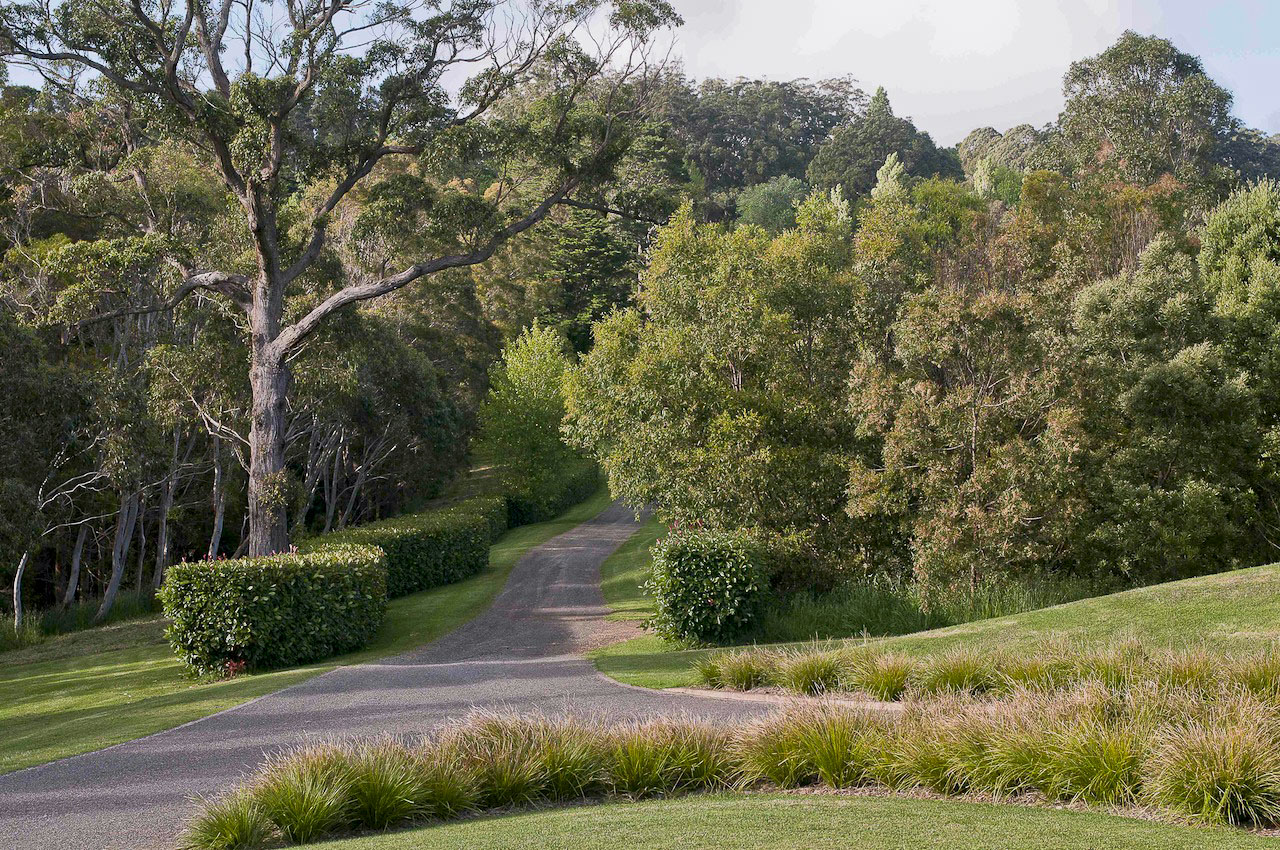
- Driveways and views. A windbreak can follow the driveway and double as an avenue, or be broken deliberately with an overlapping return to frame a view without letting the wind through.
How dense and how wide should a windbreak be?
A windbreak should filter the wind rather than block it. A good windbreak is around 40% porous. A solid barrier such as a wall or a dense conifer hedge forces the wind over the top, where it tumbles down on the lee side as turbulence a short distance behind.
Width depends on scale. On farm land the NSW Government reference design is four rows about 25 to 30 m wide, with shrubs in the outer rows to give cover at ground level and trees in the centre rows, trees about 8 m apart and a 4 m gap between the fence and the planting. Around a house garden, two or three staggered rows of mixed trees and shrubs usually give enough shelter in far less space, with the lowest, densest planting on the windward side.
| Scale | Typical layout | What it protects |
|---|---|---|
| House garden | Two or three staggered rows of shrubs and small trees, plus a clipped hedge closer in | Terraces, lawns, borders and the kitchen garden |
| Home paddocks and orchard | Three rows: shrubs outside, trees in the middle | Fruit trees, young plantings, horses and small stock |
| Farm scale | Four or more rows, 25 to 30 m wide, fenced from stock | Pasture, lambing paddocks, cattle and soil |
Which trees make good windbreaks in the Southern Highlands?
The best windbreak trees for the Southern Highlands handle frost, westerly winds and the local soils, and grow at different rates so the windbreak works early and lasts. Local eucalypts, wattles and shrubs suit most sites, especially species from the region’s own woodlands.
| Plant | Role in the windbreak | Notes |
|---|---|---|
| Ribbon gum and narrow-leaved peppermint (Eucalyptus viminalis, E. radiata) | Tall centre-row trees | Long-lived local eucalypts for the backbone of a larger windbreak |
| Snow gum (Eucalyptus pauciflora) | Medium centre-row tree | Very frost hardy, suits exposed ground and colder pockets |
| Swamp gum (Eucalyptus ovata) | Tree for low, wet ground | Tolerates frost and waterlogging along creek lines and dam edges |
| Camden woollybutt (Eucalyptus macarthurii) | Centre-row tree | A local eucalypt with a restricted range, worth planting where it naturally belongs |
| Blackwood and silver wattle (Acacia melanoxylon, A. dealbata) | Fast early shelter | Quick to establish, shorter-lived, give shelter while the eucalypts grow |
| Blackthorn (Bursaria spinosa), burgan (Kunzea ericoides), daisy bush (Olearia species) | Outer-row shrubs | Dense cover at ground level and habitat for small birds |
| Monterey cypress and pine | Dense evergreen shelter | Form many of the Highlands’ old shelter belts, but pines can seed into bushland and dense conifers are best kept away from the house on bushfire prone land |
Species are checked against the site before anything is ordered: soil, aspect, drainage, frost pockets and bushfire mapping all narrow the list. Local provenance tubestock, grown from seed collected in the region, tends to establish better than plants raised elsewhere.
Should a windbreak be native or exotic?
Most Highlands windbreaks work best as mainly native plantings with exotics used deliberately where their character is wanted. Native windbreaks provide habitat, including corridors for koalas, suit the local soils and fit the surrounding woodland. Evergreen exotics such as cypress give dense winter shelter quickly and carry the look of the old Highlands estates, but they come with trade-offs: some pines spread into bushland, some conifers carry a lot of fuel close to the ground, and deciduous trees such as poplars give no shelter in winter, when the westerlies are strongest.
Close to the house, a clipped hedge of a shelter-tolerant evergreen often does the work of a windbreak at garden scale, with a looser native windbreak further out taking the brunt of the wind.
How long does a windbreak take to work?
The shrub rows of a windbreak begin to give shelter within a few years. The tree rows take a decade or more to reach full height, which is why a windbreak goes into the ground before almost anything else on a new acreage, often in the first planting season after the master plan is drawn.
Establishment decides how quickly that happens. Seedlings or tubestock planted in rows, rather than direct seeding, allow exact spacing. Planting in autumn, or in early spring once the hardest frosts have passed, gives roots time to establish. Tree guards keep rabbits, wallabies and deer off young plants, weed control keeps the competition down for the first two or three years, and stock are fenced out completely. Losses are replaced in the next planting season so the line stays continuous.

Where a windbreak fits in an acreage master plan
A windbreak defines the edges of everything else. It sets where the house garden can be sheltered, where the orchard and kitchen garden go, and how the driveway approaches the house. On most acreage the intensively kept garden is a hectare or less, as set out in how big an acreage is and how much of it should be garden, and the windbreak wraps that zone and the home paddocks rather than the whole property. Where it follows the drive, it becomes part of the arrival, covered in more detail in driveway and entrance design for rural properties.
Nicholas Bray is a Registered Landscape Architect (RILA 958) with more than 30 years in practice, working from Moss Vale across the Southern Highlands, Sydney, the South Coast and regional NSW. Shelter planting is designed and staged with the rest of the master plan, including frost drainage, water and bushfire setbacks.
Common questions about windbreak trees
What is the fastest growing windbreak tree?
Wattles such as silver wattle and blackwood are among the quickest to give shelter in the Southern Highlands, but they are shorter-lived than eucalypts. A good windbreak pairs fast pioneer species with slower, long-lived trees so the shelter keeps working as the early plants age.
How far apart should windbreak trees be planted?
In the NSW Government’s four-row farm design, trees in the centre rows are planted about 8 m apart, with shrubs between them and in the outer rows. Spacing in a garden-scale windbreak is closer and staggered between rows so there are no gaps for the wind.
Does a windbreak make frost worse?
It can. A dense windbreak across a slope can trap cold air draining downhill and create a frost pocket above it. Leaving the downhill end open or setting the windbreak back from low ground lets the cold air drain away.
If your Southern Highlands property needs shelter before the garden can go in, book a consultation with Nicholas Bray Landscapes on 0417 278 267 or at contact@nicholasbray.net.au.
Planning your garden?
Talk to Nicholas Bray about your property.
Tell us a little about your site and what you have in mind, and we’ll be in touch to arrange a consultation.
Prefer to talk? Call 0417 278 267

About the author
Nicholas Bray, Registered Landscape Architect (RILA 958, AILA)
Nicholas Bray is the principal of Nicholas Bray Landscapes, a landscape architecture and construction business based in Moss Vale in the Southern Highlands. With 25 years of experience across landscape architecture, horticulture and environmental planning, he designs and builds gardens for large acreage estates, rural properties, vineyards, schools and commercial sites throughout the Southern Highlands, Central and Southern New South Wales.
Nicholas studied landscape architecture in Australia and Canada, and horticulture at the Royal Horticultural Society’s garden at Wisley in the United Kingdom. He has worked at the Hanbury Botanical Gardens in La Mortola, Italy, and completed projects in Spain, the United Kingdom, Singapore and Canada.
His work balances the built and natural environments with site specific planting, stonework, pools and water features, and he is well known for guiding complex landscape plans through council approval.