


An acreage in Australia has no fixed legal size. The word is real estate shorthand for land well beyond a suburban block, usually starting at about one acre (4,047 m², or roughly 0.4 hectares) and stretching to holdings of 100 acres or more. Zoning, shown on the council’s planning maps, sets what the land can be used for. For anyone who has bought acreage in the Southern Highlands, size and zoning are the first two facts to settle, because together they decide how much of the property becomes garden and how much is managed as paddock, shelter and water.
How big is an acreage in Australia?
An acreage is any residential property on a large parcel of land, and there is no agreed minimum. In practice, agents use “acreage” to describe homes on roughly one acre and above, “small acreage” or “lifestyle block” for properties of a few hectares, and “rural holding” or “farm” once the land is mainly used for production. Lenders draw their own lines as well, and larger holdings are often assessed as rural or commercial property rather than as a home.
Because the label is loose, two measures are more useful than the word itself: the area in hectares, and the zone.
Size and zoning are the first two things Nicholas Bray Landscapes checks on a rural property. The practice’s approach to rural and acreage landscaping in the Southern Highlands starts with the whole holding, then works in towards the house.

How many square metres are in an acre?
One acre is 4,046.86 m², or about 0.405 hectares. Laid out as a square, an acre measures roughly 63.6 m along each side. One hectare is 10,000 m² (a square 100 m by 100 m) and equals about 2.47 acres.
Australia measures land in metric units, so a property advertised as “5 acres” appears on survey plans and council records as about 2.02 hectares.
| Acres | Hectares | Square metres |
|---|---|---|
| 1 | 0.40 | 4,047 |
| 2 | 0.81 | 8,094 |
| 2.5 | 1.01 | 10,117 |
| 5 | 2.02 | 20,234 |
| 10 | 4.05 | 40,469 |
| 25 | 10.12 | 101,171 |
| 50 | 20.23 | 202,343 |
| 100 | 40.47 | 404,686 |
What are the dimensions of an acre?
An acre has no fixed shape. Any area of land measuring 4,046.86 m² is an acre, whether it is a square of about 63.6 m a side, a long strip or an irregular paddock following a creek. For a sense of scale, an acre is a little over half a full-size soccer pitch of 105 m by 68 m.
The acre is an old unit of measurement. The word comes from the Old English æcer, meaning a field, and an acre was roughly the amount of land a team of oxen could plough in a day. It was later standardised as a strip one furlong long (660 feet, about 201 m) and one chain wide (66 feet, about 20.1 m). The chain stayed the surveyor’s working length for generations, which is why many older rural road reserves in NSW are one chain wide. Australia moved land measurement to hectares during metric conversion in the 1970s, but acres survive in real estate listings and on the land.
What different acreage sizes mean for the landscape
Each size raises different design questions. On a Southern Highlands property, the pattern usually runs like this.
| Size | What the property usually holds | What the landscape design has to resolve |
|---|---|---|
| 1 acre (0.4 ha) | The house and garden fill most of the block | The whole block can be designed as garden. Boundary planting for privacy and shelter, drainage, and the view from the house. |
| 5 acres (2 ha) | A house garden with a paddock or two beyond | Where the garden stops, shelter on the western side, and a kitchen garden or small orchard close to the house. |
| 10 acres (4 ha) | House garden, paddocks, often a dam, and a driveway long enough to be designed | The arrival sequence, a shelter belt, water and the dam edge, and a plan staged over several years. |
| 25 acres (10 ha) | Mostly paddock, bush or regeneration, with the garden a small part of the whole | Which land is managed extensively, bushfire access and setbacks, long views, and a realistic maintenance load. |
| 100 acres (40 ha) and above | A working rural holding | Shelter belts at farm scale, how stock and machinery move around the garden, and a clear edge between house garden and farm. |
What does zoning mean for an acreage in NSW?
Zoning decides what an acreage can be used for, whether it can be subdivided and, in rural zones, often whether a house can be built at all. In NSW each council sets zones through its Local Environmental Plan. In the Southern Highlands that plan is the Wingecarribee Local Environmental Plan 2010.
The zones that most often apply to acreage are, as of October 2026:
- R5 Large Lot Residential: residential land on larger lots, usually close to a town or village.
- RU4 Primary Production Small Lots: smaller rural lots where agriculture continues alongside rural living.
- RU2 Rural Landscape: rural land where agriculture continues and the rural landscape character of the land is maintained.
- RU1 Primary Production: land kept mainly for farming.
- C3 Environmental Management and C4 Environmental Living: land with environmental values. These replaced the former E3 and E4 zones on 1 December 2021.
Minimum lot sizes for subdivision are set by the plan’s Lot Size Map rather than by the zone alone, and in rural zones the right to build a dwelling is often tied to that minimum. The NSW Planning Portal’s spatial viewer shows the zone and minimum lot size for any address, and the council or a town planner can confirm what applies to a particular property.
Bushfire prone land mapping, native vegetation rules and heritage listings sit alongside the zone, and they can decide where trees may be removed and what a development application must show.
How much of an acreage should be garden?
On most acreage, the intensively designed and maintained garden works best at a hectare or less, close to the house, with the rest of the property managed at a lower intensity. A garden stretched across the whole holding becomes a maintenance burden within a few seasons, and the parts furthest from the house are the first to be neglected.
Nicholas Bray Landscapes plans acreage in three zones:
- The house garden: terraces, hedges, borders and lawn, designed and maintained to a high standard and sheltered from the westerlies.
- The managed zone: orchard, kitchen garden, mown paths, specimen trees and the dam edge, looked after regularly but less intensively.
- The extensive zone: paddock, native regeneration, shelter belts and long grass, managed a few times a year. Native regeneration here can also reconnect koala habitat across the property.
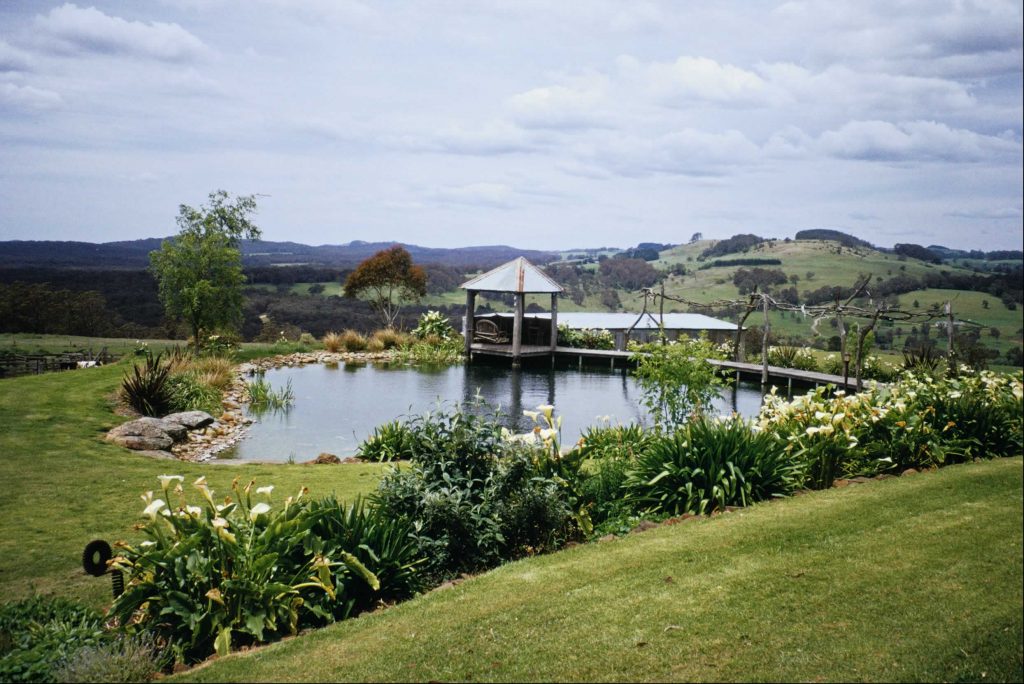
The edges between these zones need designing too. A low stone wall, a ha-ha, a clipped hedge or a change in mowing height tells the eye where the garden ends without closing off the view to the paddocks. There is more on drawing those boundaries in how the garden zones are planned around a new acreage home.
What landscaping an acreage involves in the Southern Highlands
On a Highlands acreage, the landscape work is mostly about shelter, frost, water, fire and arrival, resolved together in one master plan before planting starts.
- Shelter. Westerly winds cross the plateau through winter and spring. A shelter belt on the western side protects everything planted after it, and it takes the longest to establish, so it goes in first.
- Frost. Cold air drains downhill overnight and pools in low ground. Frost-tender planting belongs above those hollows, and a shelter belt needs gaps or a set-back so cold air can still drain past it.
- Water. Dams, tanks and the way runoff crosses a slope are designed together, so water is held where it is useful and moved away from the house. A dam within sight of the house can also become somewhere to sit, as with this ironbark dam jetty.
- Bushfire. For a new house on land mapped as bushfire prone, Planning for Bush Fire Protection 2019 sets an asset protection zone around the building, and its width depends on the surrounding vegetation and the slope. The choice and spacing of planting inside that zone is part of the landscape design, covered in more detail in the 10/50 rule and bushfire ready landscaping.
- Arrival. On a larger holding the driveway is the first experience of the property. Gates, an avenue of trees and the first view of the house are planned as a sequence. There are more ideas in driveway and entrance design for rural properties.
Soil changes the planting palette across short distances. Red basalt soils on the plateau around Robertson and Kangaloon hold water and nutrients far better than the lighter soils over sandstone around Bundanoon, and a planting plan written for one will struggle on the other.
When should a landscape architect be involved?
A landscape architect is most useful before the house is sited. The position of the house fixes its aspect, the line of the driveway, the levels around it and how much earthwork the site will need, and those decisions are expensive to undo once the slab is poured.
Where the house is already built, the starting point is a site analysis: how the land falls, where cold air and water move, which trees are worth keeping and which views deserve framing. From there a master plan sets out the garden zones and stages the work over several years, beginning with shelter.
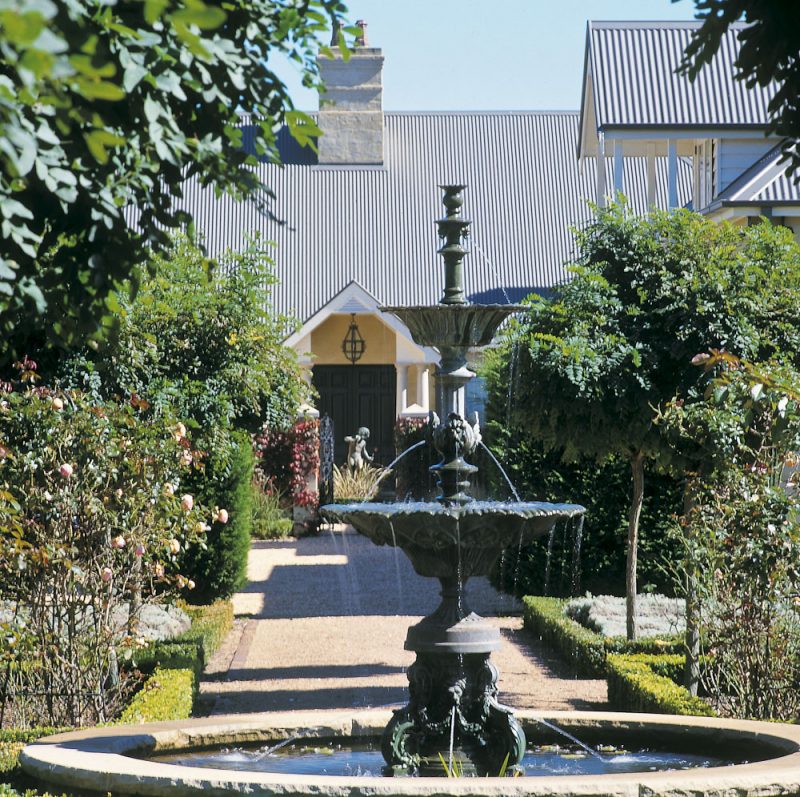
Nicholas Bray is a Registered Landscape Architect (RILA 958) with more than 30 years in practice, working from Moss Vale across the Southern Highlands, Sydney, the South Coast and regional NSW. On the practice’s Country Estate project in the Southern Highlands, a formal parterre, woodland garden and mixed borders are combined in a single master plan for the property.
Common questions about acreage size
Is an acre bigger than a hectare?
No. A hectare is about 2.47 times the size of an acre. One acre is 4,047 m² and one hectare is 10,000 m².
Is 1.5 acres a big block?
By suburban standards, yes. One and a half acres is about 6,070 m², or roughly 0.6 hectares, which is enough for a substantial house garden with room for an orchard or a small paddock. By rural standards it is a small acreage, and the whole block can usually be designed as garden.
Can a house be built on any acreage?
Not always. Whether a dwelling is permitted depends on the zone and, in rural zones, usually on whether the lot meets the minimum size on the council’s Lot Size Map. Check the zone and lot size on the NSW Planning Portal and confirm with the council before buying.
If you have bought acreage in the Southern Highlands and want the land read before anything is planted, book a consultation with Nicholas Bray Landscapes on 0417 278 267 or at contact@nicholasbray.net.au.
Planning your garden?
Talk to Nicholas Bray about your property.
Tell us a little about your site and what you have in mind, and we’ll be in touch to arrange a consultation.
Prefer to talk? Call 0417 278 267
About the author
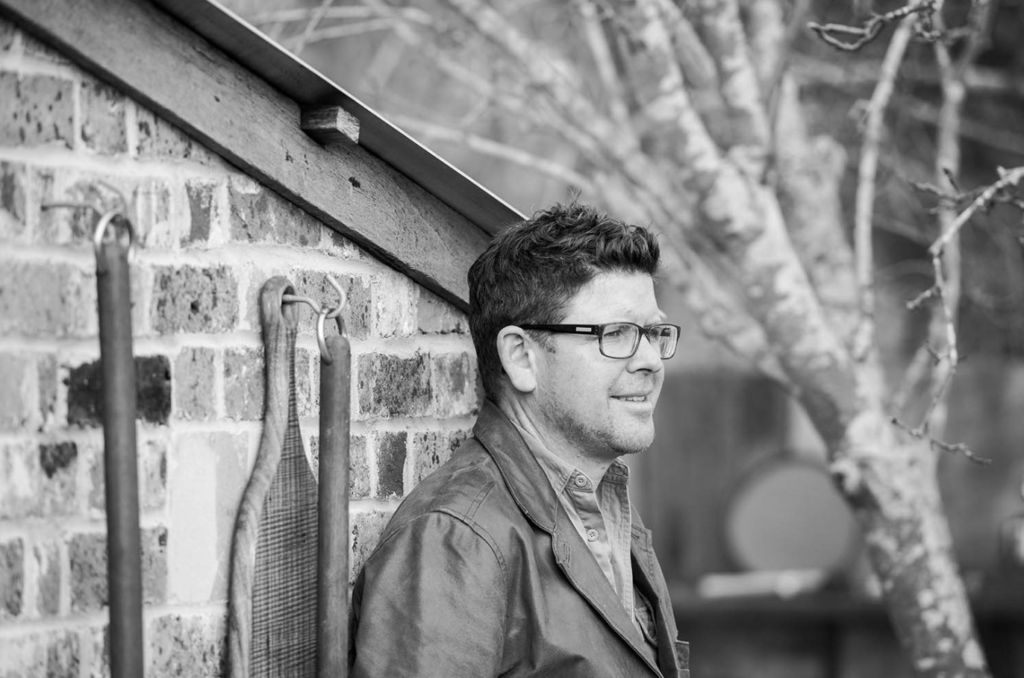
Nicholas Bray, Registered Landscape Architect (RILA 958, AILA)
Nicholas Bray is the principal of Nicholas Bray Landscapes, a landscape architecture and construction business based in Moss Vale in the Southern Highlands. With 25 years of experience across landscape architecture, horticulture and environmental planning, he designs and builds gardens for large acreage estates, rural properties, vineyards, schools and commercial sites throughout the Southern Highlands, Central and Southern New South Wales.
Nicholas studied landscape architecture in Australia and Canada, and horticulture at the Royal Horticultural Society’s garden at Wisley in the United Kingdom. He has worked at the Hanbury Botanical Gardens in La Mortola, Italy, and completed projects in Spain, the United Kingdom, Singapore and Canada.
His work balances the built and natural environments with site specific planting, stonework, pools and water features, and he is well known for guiding complex landscape plans through council approval.